 Saleleni

Your email marketing platform has an 18 to 22% open rate on a good day. Your WhatsApp messages have a 98% open rate. You are spending thousands of rands a month on email. You are using WhatsApp to answer queries from a personal phone.
That gap is the opportunity, and it’s exactly why WhatsApp eCommerce South Africa is becoming the conversation every online retailer needs to have. Most SA eCommerce brands are leaving it entirely on the table.
In South Africa, where 93 to 96% of internet users regularly access WhatsApp, consumers are comfortable asking questions, sharing preferences, and interacting with brands directly. For WhatsApp eCommerce in South Africa, the platform is not a nice-to-have channel. It is where your customers already are, every day, for hours. The question is whether your brand is meeting them there with a structured system or an informal, reactive chat from someone’s personal phone. Xictron
This article explains what WhatsApp commerce actually is, why most SA brands are using it wrong, and what a properly structured WhatsApp revenue system looks like in practice.
Table of Contents
- The difference between using WhatsApp and using WhatsApp properly
- What the WhatsApp Business API is and why the free app is not enough
- The three pillars of a proper WhatsApp commerce system
- Pillar 1: Abandoned cart recovery
- Pillar 2: Post-purchase engagement
- Pillar 3: Proactive campaigns and lifecycle flows
- What POPIA requires before you send a single message
- How to get started without overwhelming your team
- The brands that win in SA eCommerce in 2026
The difference between using WhatsApp and using WhatsApp properly
Most SA eCommerce brands fall into one of three categories.
The first group uses WhatsApp reactively: responding to customer queries that come in, answering stock questions, handling complaints. This is useful but entirely passive. The business is on WhatsApp only when the customer initiates contact.
The second group has set up the free WhatsApp Business app and added a product catalogue. They feel more organised. But the free app has a hard ceiling: it can only be used on one device at a time, it has no automation, no integration with their Shopify or WooCommerce store, and no ability to send triggered messages based on customer behaviour. It is a better version of the personal phone approach, not a commerce system.
The third group has built a structured WhatsApp commerce operation on the WhatsApp Business API. They have automated cart recovery messages, order updates, post-purchase flows, and targeted campaigns running around the clock. Their WhatsApp channel generates measurable revenue. Their team manages it from a shared inbox. Their customer data flows into the same analytics system as their email and paid media.
The gap between group two and group three is not a technology gap. It is a knowledge gap. Most SA Brand Owners have never had the system explained to them.

What the WhatsApp Business API is and why the free app is not enough
The WhatsApp Business API is the version of WhatsApp designed for businesses that need to operate at scale: multiple team members managing conversations from a shared inbox, automated messages triggered by customer behaviour, integration with eCommerce platforms, and the ability to send outbound messages to customers who have opted in.
It is ideal for any business handling more than 20 conversations per day, or any business wanting automation. Consider switching to the API if you are losing leads after hours, customers message at 9 PM and you only reply at 8 AM the next day, by which time they have gone to a competitor. Intelligentretail
You do not access the API directly from Meta. You access it through a BSP (Business Solution Provider), a platform that gives you the interface, the automation tools, and the integration layer. In SA, platforms like WATI, Klaviyo (for Shopify stores), Omnisend, and local providers with POPIA-compliant infrastructure all offer WhatsApp API access.
WhatsApp messages have a 98% open rate compared to roughly 20% for email. That single data point is why serious eCommerce operations are treating WhatsApp as a primary revenue channel rather than a customer service fallback.
On pricing: Meta shifted to a per-message model in mid-2025. The cost per marketing message in South Africa is affordable at SA revenue scales, and the free tier (1,000 free service conversations per month) means most brands can test the system before meaningful costs arise. The ROI calculation is not complicated. If a single recovered abandoned cart is worth R800 to your business, you need to recover very few carts per month for the API cost to pay for itself.
What is the WhatsApp Business API and how does it differ from the free WhatsApp Business app?
The WhatsApp Business API is the enterprise version of WhatsApp designed for businesses needing automation, multi-agent team access, eCommerce platform integration, and the ability to send triggered outbound messages at scale. Unlike the free WhatsApp Business app, which supports only one device and has no automation capability, the API connects to your Shopify or WooCommerce store, fires messages based on customer behaviour like cart abandonment and order placement, and allows multiple team members to manage conversations from a shared inbox.
The three pillars of a proper WhatsApp commerce system
A properly built WhatsApp eCommerce system is not a single tool. It is three interconnected functions, each doing a distinct job. Most brands that “use WhatsApp for eCommerce” are only running one of them, or running none of them systematically.
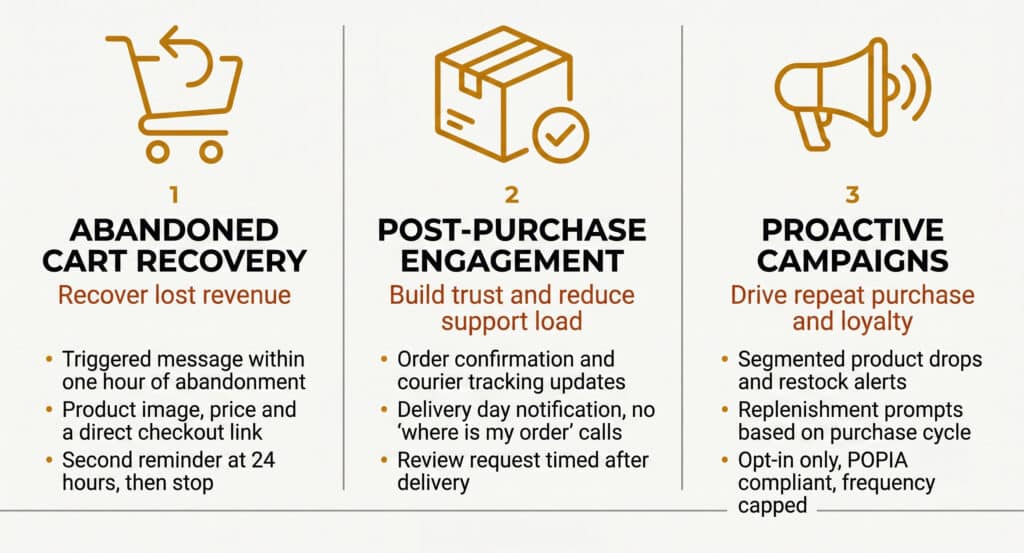
The three pillars are: abandoned cart recovery, post-purchase engagement, and proactive campaigns. Together they cover the full customer lifecycle from the moment of lost intent through to repeat purchase and loyalty.
Pillar 1: Abandoned cart recovery
This is the highest-immediate-ROI use case, and the one that most clearly illustrates why WhatsApp outperforms every other channel for SA eCommerce brands.
The global average cart abandonment rate sits at 76.8%, meaning for every 10 customers who add a product to their cart, only around 2 to 3 complete the purchase on their first visit. For a brand doing R500,000 in monthly online revenue, the abandoned cart pool represents a multiple of that number in lost potential. Lengow
The standard recovery approach is email. The problem is visibility. Email abandoned cart recovery has a 20% open rate. WhatsApp has 98%. That single stat explains why ecommerce brands in 2026 are moving their most critical customer communications to WhatsApp.
WhatsApp abandoned cart recovery produces recovery rates of 10 to 25%, compared to 5 to 8% for email. The gap comes from three factors: WhatsApp messages are seen almost immediately, the channel allows two-way conversation (so a customer who has a question about sizing or delivery can get an answer in real time rather than leaving), and rich media support means the cart recovery message can show the actual product images, not just a link. LocalPros
The structure that works:
Message 1 (30 to 60 minutes after abandonment): A friendly, personalised reminder showing the specific products left, the customer’s name, and a direct cart link. No discount offered. This message alone recovers 8 to 12% of abandoned carts because many abandoners simply got distracted.
Message 2 (24 hours after abandonment): Addresses common hesitations. Social proof, a note about your return policy, or free shipping if applicable. Still no heavy discount. Recovers an additional 5 to 8%.
Message 3 (48 hours after abandonment): A final message with a time-limited incentive for customers who have not responded. This is the only point at which a discount makes sense. Send more than three messages without a response and you are training customers to tune you out.
The pattern is consistent across implementations: WhatsApp outperforms email on recovery rate, response rate, and average order value from recovered carts. The channel is better suited to the task. Revenuealot
One critical setup requirement: you must collect WhatsApp opt-in at checkout. You cannot send outbound messages to customers who have not explicitly consented. The opt-in checkbox at checkout (“Receive order updates and offers on WhatsApp”) is the foundation of everything that follows, and it is the step most brands skip when they first try to implement this.
Pillar 2: Post-purchase engagement
Recovering the abandoned cart solves a one-time problem. Post-purchase engagement builds the relationship that produces the second, third, and fourth orders.
“Where is my package?” questions account for 40 to 60% of all customer support inquiries in ecommerce. Automating shipping updates through WhatsApp eliminates the vast majority of these support tickets, freeing your team for higher-value work and proactively building customer trust before problems can emerge. Fluidsa
A structured post-purchase WhatsApp flow includes:
Order confirmation: Sent immediately after purchase. Confirms the order details and sets expectations on delivery timing. This message alone dramatically reduces inbound support queries.
Dispatch notification: Sent when the order is picked and packed, with tracking information embedded directly in the message. Customers do not need to log into a portal or check their email.
Delivery confirmation: Sent when the order is delivered, with a prompt to review the product or reach out if anything is wrong.
Post-delivery follow-up (5 to 7 days after delivery): A check-in message asking how the customer is finding the product, with a soft cross-sell recommendation based on what they purchased. This is the moment most brands miss entirely.
This sequence does two things simultaneously. It reduces your support load (because proactive updates answer the question before the customer has to ask it) and it creates multiple touchpoints that build brand trust after the sale.
A 5% increase in customer retention correlates with a 25% increase in profit. Loyalty programme members who redeem rewards spend an average of 3.1 times more per year than non-redeeming members. The post-purchase WhatsApp sequence is the infrastructure that makes repeat purchase and loyalty possible, because it keeps the brand present in the customer’s daily messaging environment rather than buried in an email inbox.
Pillar 3: Proactive campaigns and lifecycle flows
This is where WhatsApp moves from a transactional tool into a full marketing channel. It is also the pillar that requires the most discipline to execute without damaging the relationship you have built.
SA consumers tolerate 1 to 2 promotional messages per week from brands they trust. Beyond that, opt-out rates rise sharply. Frequency discipline is the single most important factor in maintaining engagement rates. OpenTools.ai
Within that constraint, the campaign types that perform well for SA eCommerce brands include:
Back-in-stock alerts: Customers who were browsing an out-of-stock product and opted in to be notified. This is one of the highest-conversion message types in any channel because the intent is already established.
New product launches to existing customers: Segmented by purchase history, so the recommendation is relevant. A customer who bought running shoes does not want to hear about kitchen appliances.
Win-back campaigns for lapsed customers: Customers who have not purchased in 90 or more days, triggered automatically with a personalised message and an incentive. Far more effective than the equivalent email because the message is actually seen.
VIP and loyalty updates: Points balances, tier upgrades, exclusive early access. This is the use case where WhatsApp’s ability to support an always-on, two-way conversation matters most. A customer who receives a points update and replies “how do I redeem this?” can be answered immediately, in the same thread, by either an AI chatbot or a team member. Xictron
The revenue data from brands running all three pillars is consistent. WhatsApp generates 6 times higher revenue per message than email, with 2 to 3 times higher conversion rates and 12 times higher conversion rates than traditional channels overall. Ozow
What POPIA requires before you send a single message
This section is not optional reading. POPIA (the Protection of Personal Information Act) governs all business communication in South Africa, and WhatsApp marketing is explicitly covered.
You must obtain clear, affirmative consent from customers before sending them any marketing messages on WhatsApp. This means a checkbox on a form that is not pre-ticked, or a WhatsApp message where the customer explicitly replies to confirm. Every marketing message must include a way for the customer to unsubscribe. Non-compliance can result in fines of up to R10 million or imprisonment.
The practical implication for SA eCommerce brands:
You need two separate opt-ins. The first is for transactional messages: order updates, shipping notifications, delivery confirmations. These are utility messages and most customers will opt in willingly because they are genuinely useful. The second is for marketing messages: promotions, new products, win-back campaigns. This requires a separate, explicit opt-in, typically a checkbox at checkout or a dedicated sign-up flow.
You cannot import a list of phone numbers from your CRM and start sending WhatsApp messages to customers who have not specifically opted into the WhatsApp channel. Email opt-in does not transfer to WhatsApp opt-in. This is the compliance gap that most brands miss when they first consider WhatsApp as a channel.
Get the opt-in infrastructure right from day one. Building your WhatsApp subscriber list the compliant way is slower initially but produces a list of engaged customers who have actively chosen to hear from you on the channel, which is why the engagement rates are so dramatically higher than purchased or imported lists.
Is WhatsApp marketing legal in South Africa under POPIA?
WhatsApp marketing is legal in South Africa under POPIA, provided businesses obtain explicit, affirmative consent from customers before sending any marketing messages. Pre-ticked checkboxes do not constitute valid consent. Every marketing message must include an unsubscribe option. Transactional messages such as order updates and delivery notifications require a separate opt-in from promotional campaigns. Non-compliance can result in fines of up to R10 million.
How to get started without overwhelming your team
The most common reason SA brands do not implement WhatsApp commerce properly is not cost and it is not technical complexity. It is the fear of building something they cannot manage.
The practical starting sequence:
Step 1: Get on the API. Choose a BSP that integrates with your platform (Shopify or WooCommerce) and has SA-based support or at minimum POPIA-compliant infrastructure. WATI, Klaviyo’s WhatsApp integration, and Omnisend are the most commonly used by SA mid-market eCommerce brands. The API activation process takes 5 to 10 business days for Meta verification.
Step 2: Set up your opt-in collection. Add a WhatsApp opt-in checkbox to your checkout flow for transactional messages. Add a second opt-in for marketing messages, either at checkout or on a dedicated sign-up page. Do not move to step 3 until this is in place.
Step 3: Launch the three core flows. Abandoned cart recovery, order confirmation, and shipping update. These three automated flows cover 80% of the immediate ROI and run without any ongoing effort from your team once they are set up. Submit your message templates to Meta for approval (typically within a few hours to 48 hours for utility templates).
Step 4: Test with a small cohort. Run the flows with 100 to 500 customers first. Verify delivery rates, engagement, and revenue attribution before scaling.
Step 5: Add campaigns once the foundation is stable. Back-in-stock alerts and win-back campaigns are the highest-performing additions after the core flows are proven.
For brands evaluating which tools to use and how they connect to the broader AI and automation stack, our AI readiness audit maps your business against the AI tools that will actually deliver ROI, so you invest in the right ones the first time.
The total setup cost for most SA mid-market brands (BSP platform plus Meta API costs) sits between R500 and R2,500 per month depending on message volume. At an average order value of R800 and a 15% cart recovery rate on 500 abandoned carts per month, that investment pays for itself in the first week.
How should a South African eCommerce brand start with WhatsApp commerce?
A South African eCommerce brand should start WhatsApp commerce by choosing a WhatsApp Business API provider (BSP) that integrates with their platform, setting up POPIA-compliant opt-in collection at checkout, and launching three core automated flows: abandoned cart recovery, order confirmation, and shipping updates. These three flows cover the majority of the immediate ROI and run automatically once set up. Proactive campaign flows (back-in-stock alerts, win-back sequences) should be added once the core system is stable and the subscriber list is growing.
The brands that win in SA eCommerce
WhatsApp’s evolution from a simple chat channel into a primary commerce and service interface is set to continue over the next two to three years, with the platform effectively becoming a storefront, sales assistant, and support agent all in one. More of the customer journey will take place inside the channel as consumers move away from downloading apps or navigating websites and toward a more fluid conversational commerce experience.
SA is uniquely positioned for this shift. Mobile-first consumer behaviour, near-universal WhatsApp penetration, and a market where brand trust is still being built through every interaction mean that the brands investing in WhatsApp as a structured channel right now are building a compounding advantage.
The brands not investing are leaving open rates of 98% to their competitors. They are watching their email open rates sit at 20% and concluding that customer communication is just hard. It is not hard. It is on the wrong channel.
For SA brands wanting to understand where WhatsApp commerce fits within a broader digital and AI channel strategy, understanding where your business stands on AI and digital channel readiness is the structured starting point.
The platform is ready. The consumer behaviour is there. The only thing missing for most SA brands is the decision to treat WhatsApp as seriously as they treat their email list.
Ready to turn WhatsApp into a proper revenue channel for your SA eCommerce business?
Book a free 30-minute discovery call with the Saleleni team. We will look at your current customer communication setup, your platform, and your team’s capacity, and tell you honestly what a structured WhatsApp commerce system would look like for your specific operation.