 Saleleni

The shift isn’t coming. It’s here.
This morning, E-Commerce Times confirmed what practitioners have been watching build for months: unified platforms and agentic AI are no longer a 2027 forecast, they are the dominant force reshaping how global eCommerce operates right now, in 2026. And the data is no longer directional. The agentic AI segment in retail alone hit $60.43 billion in 2026, a figure that would have seemed implausible eighteen months ago.
For South African retailers and eCommerce brands, the instinct might be to treat this as a global story. It isn’t. The infrastructure decisions you make in the next six to twelve months will determine whether your business is positioned to compete when agentic commerce becomes the norm in this market — or whether you’re retrofitting under pressure.
This post explains what is actually happening, why the retailer pushback narrative matters as much as the AI adoption one, and what SA brands should be doing right now.
Table of Contents
- What agentic AI in eCommerce actually means
- The retailer pushback story nobody is leading with
- Why this is an SA problem, not just a global one
- What forward-thinking brands are doing now
- Where to start if you’re behind
What agentic AI in eCommerce actually means
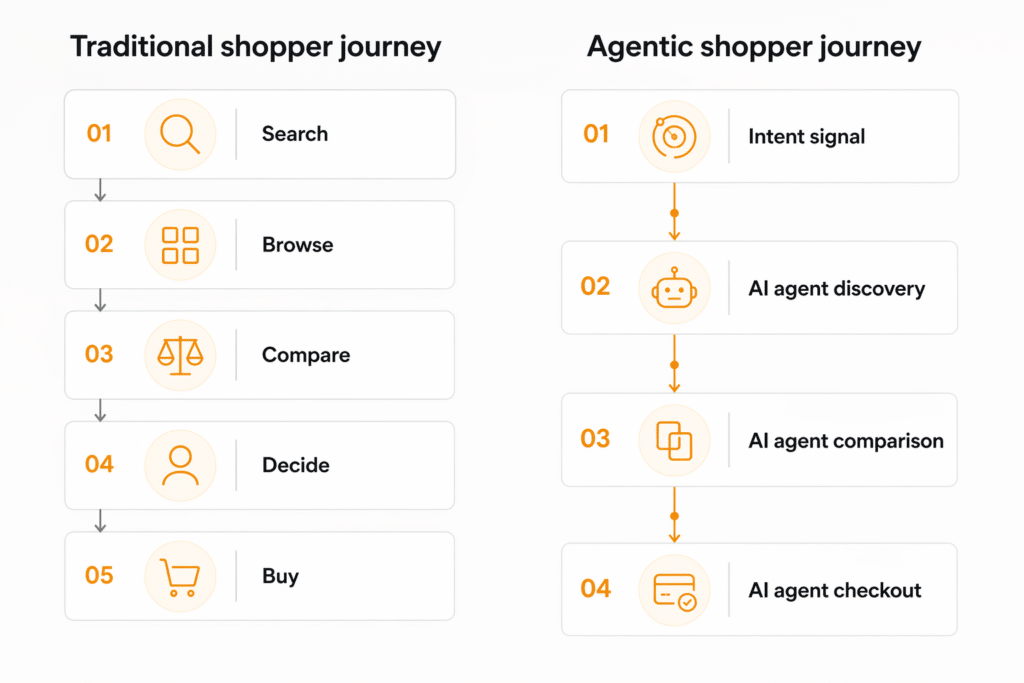
Agentic AI refers to AI systems that don’t just recommend, they act. They discover products, compare options, negotiate terms, and complete purchases on a user’s behalf, with minimal or no human intervention at each step.
Amazon’s Rufus AI shopping assistant now includes an “Auto Buy” button that authorises the chatbot to complete purchases when users reach a target price or discount level. OpenAI’s Instant Checkout feature turned its platform into an end-to-end shopping experience. Perplexity’s agentic shopping tool spots intent and pulls on users’ search history to personalise recommendations.
These are not prototypes. They are live, scaled products being used by millions of consumers globally right now.
The implication for retailers is significant: AI agents will require impeccable product data and streamlined checkout processes, as any discrepancy may lead to instant consumer redirection to more reliable competitors.
When an AI agent is doing the shopping, it doesn’t forgive a slow page load, a missing product attribute, or an inconsistent price between your website and your marketplace listing. It moves on in milliseconds.
What is agentic AI in eCommerce?
Agentic AI in eCommerce refers to AI systems that autonomously complete purchasing tasks on behalf of consumers — including product discovery, comparison, and checkout — without requiring human input at each stage. Retailers must ensure their product data, pricing, and checkout infrastructure meet the standards these agents require, or risk being bypassed in favour of competitors whose data is cleaner and more accessible.
The retailer pushback story nobody is leading with
Here is the part of this story that most coverage glosses over, and that SA brands should be paying close attention to.
Some eCommerce platforms, including Shopify and Amazon, are starting to resist activity from external AI agents inside their ecosystems. Walmart recently added guidelines to its website that prevent agents from taking users to checkout pages or placing orders.
This is not a contradiction. It is a power struggle, and it reveals the commercial stakes underneath the technology story.
If tools like Perplexity’s Comet take over product discovery and purchasing workflows, it could undermine retailers’ search and ad systems. Brands that depend on sponsored placements, display ads, and keyword-based ads could lose insights into shopper behaviour and have less direct exposure to high-intent, ready-to-buy consumers.
For SA brands selling on Takealot or Amazon SA, this tension matters directly. The platforms you depend on for distribution are simultaneously developing their own AI agents and defending against others’. Your visibility and your paid media returns exist inside an ecosystem that is being restructured around you.
The brands that will navigate this well are not the ones who wait for the dust to settle. They are the ones building the underlying capability now: clean data, strong direct-to-consumer infrastructure, and an AI strategy that doesn’t make them entirely dependent on any single platform’s algorithm.
Why this is an SA problem, not just a global one
South African eCommerce has historically lagged global markets by twelve to twenty-four months on major technology shifts. That lag has sometimes been an advantage — early mistakes get made elsewhere, and local businesses can learn from them. But agentic commerce is different in two important ways.
First, the global platforms SA brands rely on are already live with agentic features. Amazon SA operates on the same infrastructure as Amazon globally. When agentic purchasing becomes the default behaviour for international consumers shopping on Amazon, that behaviour pattern does not stop at the Limpopo River.
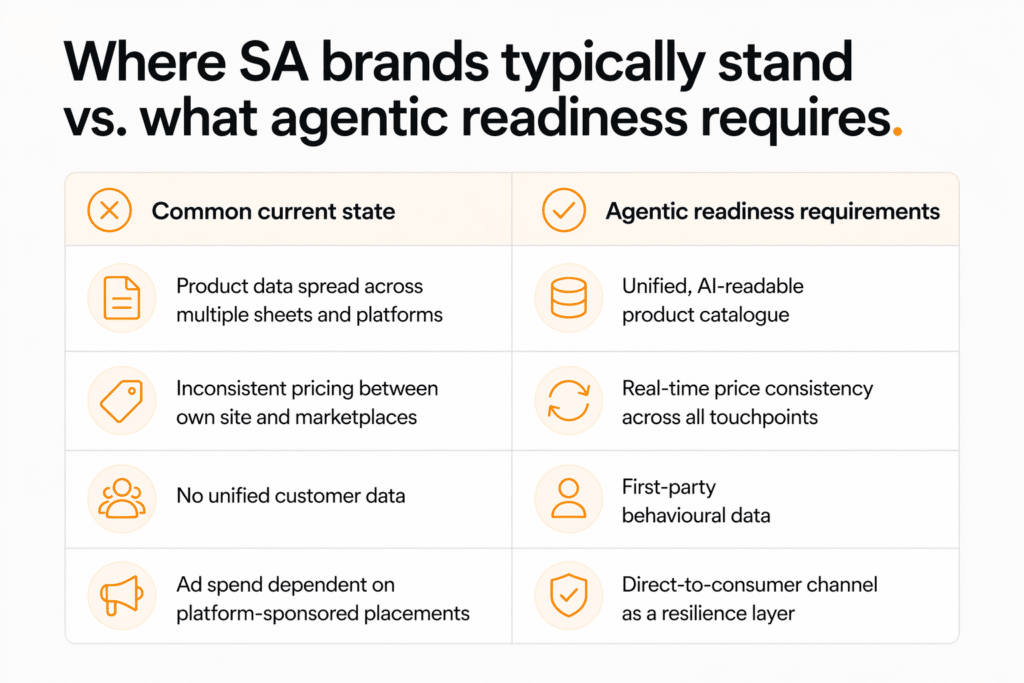
Second, the data and infrastructure requirements for agentic readiness are not quick fixes. AI performs best when it draws from unified, well-governed data across eCommerce platforms, marketing channels, and customer touchpoints. Building that foundation takes time — typically six to twelve months of deliberate work for a mid-market retailer. Waiting until agentic commerce is visibly affecting your SA conversion rates before starting that work puts you twelve months behind a train that has already left.
What forward-thinking brands are doing now
The retailers making the right moves in this environment are not necessarily the ones spending the most on AI. They are the ones doing the unglamorous foundational work that makes AI viable when it matters.
Specifically:
- Auditing and consolidating their product data. Every attribute, every image, every pricing data point — cleaned, unified, and structured in a way that is readable by both search engines and AI systems.
- Strengthening their direct-to-consumer channel. Not as a replacement for Takealot or Amazon SA, but as a resilience layer. A brand with a strong D2C operation is less exposed when platform algorithms shift.
- Mapping their AI opportunity before buying tools. Implementation should include continuous evaluation, as AI systems require ongoing monitoring, testing, and optimisation to maintain accuracy and business value over time. That discipline starts with understanding where AI creates value in your specific operation, before any vendor is engaged.
- Preparing their teams. The technology exists. The gap is consistently in the team’s ability to act on AI outputs. Brands investing in structured AI capability-building now are reducing the implementation risk of every AI project that follows.
What should SA eCommerce brands do to prepare for agentic AI?
South African eCommerce brands preparing for agentic AI should prioritise four actions: consolidating and cleaning their product data across all platforms, strengthening direct-to-consumer infrastructure as a resilience layer, conducting a structured AI readiness assessment before investing in tools, and building team capability to interpret and act on AI-generated outputs.
Where to start if you’re behind
Most SA eCommerce brands are behind on this, and that is a statement of market reality, not a criticism. The pace of change in AI has been genuinely difficult to track, let alone plan around.
The most useful starting point is not a tool purchase. It is an honest assessment of where you currently stand: what your data looks like, what your team is capable of, and where the highest-ROI AI opportunities exist in your specific business.
That is exactly what our AI readiness audit is designed to deliver. It is a structured assessment, not a sales pitch for a particular tool — that gives you a prioritised roadmap based on your actual business, your actual data, and your actual team.
If today’s headlines have created the urgency to finally answer the question “where do we stand on AI?” — that is a productive response to act on.
Book a free 30-minute discovery
The brands that will lead SA eCommerce in three years are making unglamorous infrastructure decisions right now. The agentic shift will not announce itself with a clear start date. It will simply become visible in your traffic, your conversion rates, and your marketplace rankings, by which point the preparation window has closed.
The time to assess your readiness is before you need it.
Book a free 30-minute discovery call with the Saleleni team. We’ll tell you honestly whether your data, infrastructure, and team are positioned for the AI shift, and what a structured readiness audit would involve for your specific operation.