 Saleleni
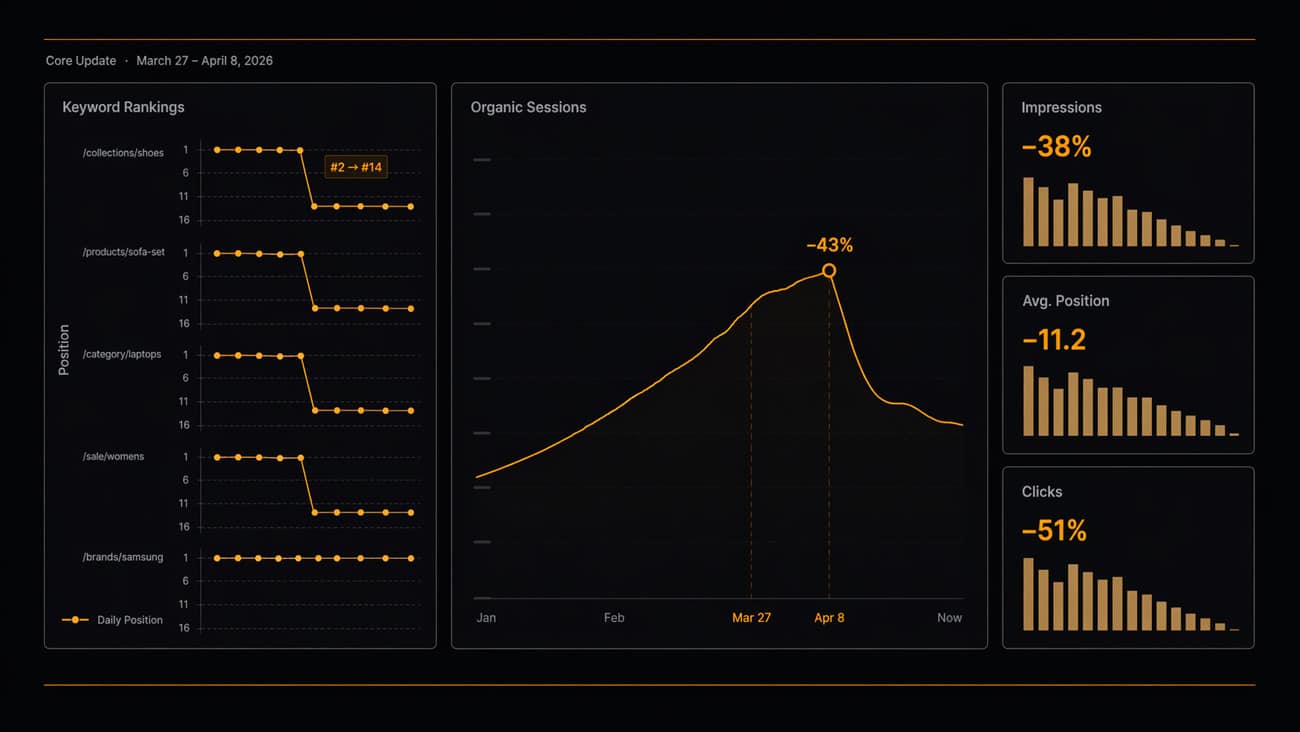
If your organic traffic dropped in late March or early April and you haven’t found a clean explanation, stop looking at your ad account. The answer is in your content.
Google’s March 2026 core update, the first broad core update of 2026, began rolling out on March 27 and completed on April 8. Over 55% of websites experienced noticeable changes in rankings. eCommerce was one of the hardest-hit sectors. And the pattern across affected sites is consistent enough to act on right now.
This post explains what the update actually changed, which types of eCommerce content took the worst of it, and what a structured response looks like.
Table of Contents
- What this update was and what it wasn’t
- What Google actually targeted
- The eCommerce impact: who lost and who gained
- The programmatic SEO reckoning
- A new mechanism SA brands need to understand
- What a structured response looks like
- What this means for SA eCommerce specifically
What this update was and what it wasn’t
The March 2026 core update is a broad ranking recalibration. It’s not a penalty, not a manual action, and not a targeting of any single industry or content format.
A ranking drop during a core update does not automatically mean a site violated a rule, got hit for spam, or needs a technical emergency fix. In many cases, it means the relative value of competing pages changed. Google’s systems reassessed how pages across the web score on relevance and quality, and some pages that were previously over-rewarded dropped, while genuinely useful content gained.
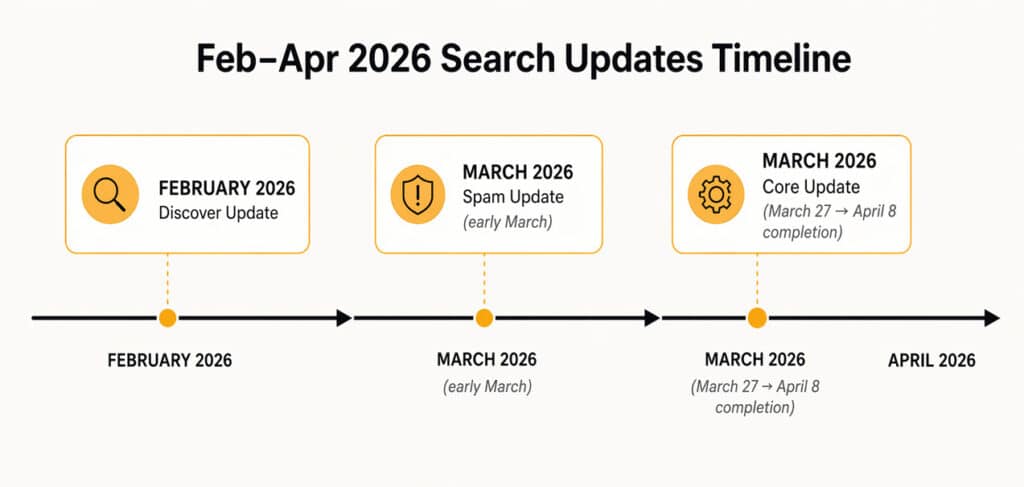
It followed two other notable update events in close proximity: the February 2026 Discover update and the March 2026 spam update. That timing alone is enough to create confusion in analytics, rank trackers, and internal reporting. If your traffic has been erratic since February, not everything you’re seeing is the core update. Segment your analysis by page type and date before drawing conclusions.
What Google actually targeted
Google described this as a regular update designed to surface more relevant and satisfying content. That language signals continuity, not a new framework. The direction has been consistent since the Helpful Content update in 2022 and its absorption into core ranking systems in March 2024.
What the data shows across thousands of affected sites:
Thin content at scale. Sites running large volumes of short, surface-level articles — the kind that cover a topic without ever going deep — saw significant drops.
Derivative content without original perspective. Pages that summarise the top 10 results without original data, first-hand experience, or a unique perspective are the single most consistent losers across core updates in 2025–2026.
AI-generated content at volume without editorial judgment. Google does not penalise content simply because it was generated by AI. However, the update significantly devalued scaled, low-effort AI content. The kind generated at volume without human editing, original insight, or first-hand experience.
The inverse is equally clear. Sites with original research and proprietary data saw average visibility gains of approximately 22%.
The eCommerce impact: who lost and who gained
eCommerce was one of the sectors with the highest volatility. Early data shows health, finance, and ecommerce moved the most, probably because that’s where the highest concentration of thin or unhelpful content sits.
The pattern within eCommerce is directional and worth understanding precisely.
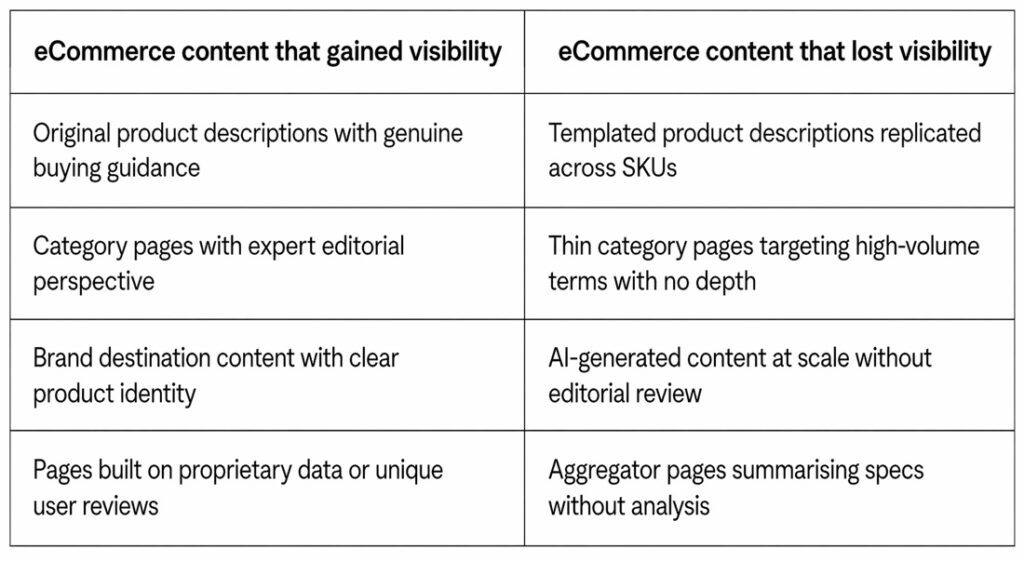
The improvements were concentrated around brands with clearer product identity, stronger brand pull, or a tighter fit for the query. Declines hit retailers on broader, more interchangeable category demand — retailers such as Wayfair, Walmart, Best Buy, and Target were more often hit on broad commercial queries, third-party brand demand, and high-volume product searches where multiple retailers can plausibly compete.
The signal: being a large retailer does not protect you. Being a destination brand does. A brand site that behaves like a destination is in a stronger position than one that relies on commodity product copy.
The programmatic SEO reckoning
This is the section that matters most for eCommerce brands running large content operations, and the one where the March 2026 update delivered its harshest verdicts.
Three patterns were explicitly identified as violations of Google’s scaled content abuse policy: mass AI page generation without meaningful editorial review, pure template-with-variable substitution at scale, and aggregator sites adding no value beyond the source data they scraped.
Sites generating thousands of near-identical pages through AI or template automation, without genuine added value per page, saw ranking losses of 60 to 90%. The classic examples of what got hit: city-specific pages that only swap the location name, product comparison pages that aggregate specs without analysis, and “best X for Y” pages repeating the same template across thousands of keyword variations.
The practical threshold that emerged from post-update analysis: does the page provide value that cannot be replicated by an AI summary of existing search results? If a user would get an equivalent answer from a Google AI Overview, the page does not clear the bar.
What did Google’s March 2026 core update do to programmatic SEO?
Google’s March 2026 core update significantly penalised programmatic SEO strategies built on template-and-variable-substitution at scale, particularly AI-generated location pages, thin product comparison pages, and aggregator content without editorial value. Sites using these approaches saw ranking losses of 60 to 90%. The update does not eliminate programmatic SEO, but it raises the quality bar to require genuine data differentiation per page.
A new mechanism SA brands need to understand
The most significant structural change in this update is not widely understood yet, and it changes the risk calculation for any eCommerce site with a large content footprint.
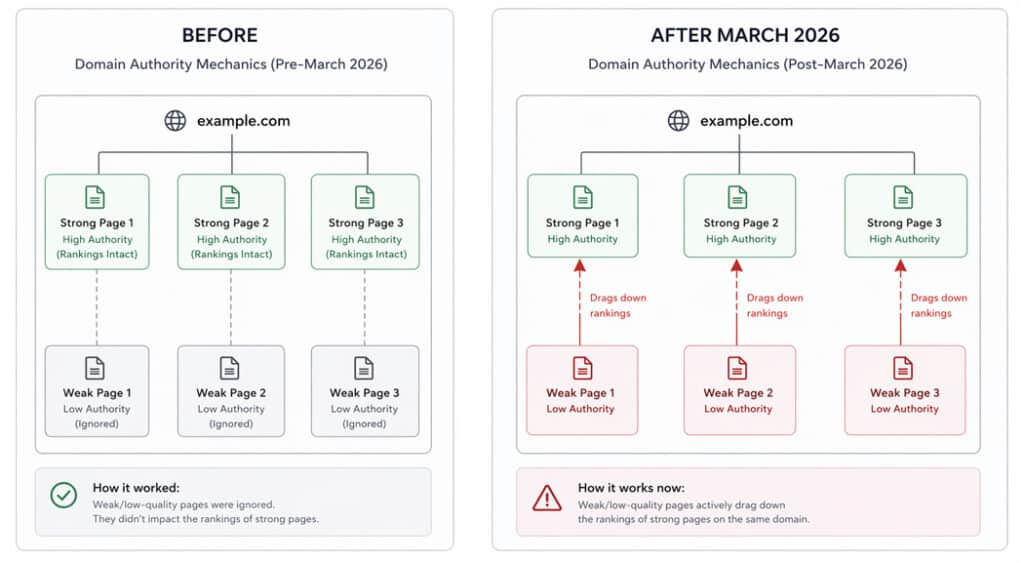
Previously, a site could carry thousands of low-quality programmatic pages with limited downside. The weak pages were largely ignored by Google’s systems while stronger pages on the domain continued to rank. That model is gone.
Post-March 2026, the quality signal from the weakest pages on a domain now drags down domain-level authority. A large catalogue of thin, templated pages does not sit quietly in the index anymore, it actively suppresses the performance of your stronger content.
For eCommerce brands with large SKU catalogues, automated location pages, or legacy blog content generated at volume, this is the finding that demands immediate attention. The question is no longer just “which of our pages are underperforming?” It is: “are our weakest pages costing our best pages their rankings?”
What a structured response looks like
Recovery from a core update is not a one-week fix. But the response has a clear sequence.
Step 1: Diagnose before touching anything. Open Google Search Console. Set a comparison window of March 1–23 (before) versus April 9 to today (after). Sort by pages with the biggest position decline, not just traffic drop. Export the top 50 losers and look for a common thread: same content type, same topic cluster, templated structure.
Step 2: Identify your weakest programmatic pages. If you have more than a few hundred automatically generated pages, location variants, SKU comparison pages, category filters — audit them honestly against the threshold: does this page answer a distinct user query that no other page on your site already answers? If not, it is a consolidation candidate.
Step 3: Consolidate, don’t just delete. Redirect thin pages to stronger parent pages where possible. Deletion without redirection loses any residual link equity the page has accumulated. Consolidation is safer and typically faster to recover from.
Step 4: Invest in genuine differentiation on pages you keep. For programmatic pages built on unique structured data, verified business directories, live pricing comparisons, real inventory data, the update did not hurt them. The bar is whether the data is genuinely unique and the page answers a real user query no other page on your domain already covers.
On recovery timelines: Sites with fewer than 10,000 programmatic pages and clear unique data differentiation typically see early positive signals within 30 days. Larger sites with significant consolidation work should plan for a 3 to 6 month recovery window — likely aligned with Google’s next broad core update.
How long does recovery from a Google core update take?
Recovery from a Google core update typically takes one to three months, depending on the scope of changes made and the size of the affected content footprint. Sites with fewer than 10,000 affected pages implementing clear quality improvements often see early positive signals within 30 days. Larger sites with significant content consolidation work required should plan for a 3 to 6 month window, with meaningful recovery typically coinciding with Google’s next broad core update.
What this means for SA eCommerce specifically
South African eCommerce brands face two specific exposures from this update that are worth naming directly.
First, marketplace catalog content. Many SA brands managing Takealot or Amazon SA listings have syndicated or closely mirrored that content onto their own sites, product descriptions, spec sheets, category copy, without meaningful differentiation. That content is now structurally exposed. If your product pages read identically to what appears on the marketplace listing, they are not providing the original value Google’s systems now require.
This is an area where structured marketplace optimisation and catalog management work, treating your own-site product content as distinct from your marketplace feeds becomes an SEO decision, not just a brand one.
Second, AI Overviews are now part of the competitive landscape in a way they weren’t twelve months ago. For 14% of shopping queries and growing, being cited in an AI Overview matters more than ranking first in traditional results. The content signals that earn AI citations are the same signals this core update rewards: original data, structured markup, and authoritative expertise.
This is not a separate problem from search strategy, it is the same problem. The content architecture that recovers from the March 2026 update is the same architecture that positions a site to be cited in AI Overviews. Both reward original, structured, expert-led content.
The brands that respond to this update by doing the consolidation work and investing in genuine content differentiation will come out of 2026 in a structurally stronger position. The ones who treat it as a temporary fluctuation to ride out will face the same reckoning at the next update, compounded.
Not sure what this update means for your site specifically?
Book a free 30-minute discovery call with the Saleleni team. We’ll look at your content footprint, identify where your exposure sits, and tell you honestly what a structured response would involve for your specific operation.