 Saleleni
There is no shortage of AI tools competing for your attention right now. Personalisation platforms. Catalog automation software. AI-powered search engines. Demand forecasting models. Conversational shopping agents. The vendor landscape has exploded, and every product claims to be the one that will transform your eCommerce operation.
Most of them won’t. Not because the technology doesn’t work (in the right context, it does) but because most SA eCommerce businesses aren’t yet set up to make it work. And the gap between “the tool functions correctly” and “the tool generates ROI in your specific business” is where most AI investments go quiet.
This guide covers the five AI use cases generating real, measurable returns in eCommerce right now, the tools within each category worth evaluating for an SA mid-market context, and, critically, the readiness questions you need to answer before spending a rand on any of them.
This is not a ranking. It is a framework for making a confident, budget-aware decision about where AI actually fits in your business right now.
Table of Contents
- The problem with most AI tool lists
- How to evaluate AI tools for an SA business context
- The five use cases generating real ROI
- Use Case 1: Personalisation and product recommendations
- Use Case 2: AI-powered search and discovery
- Use Case 3: Catalog automation and data enrichment
- Use Case 4: Email and retention automation
- Use Case 5: Demand forecasting and inventory management
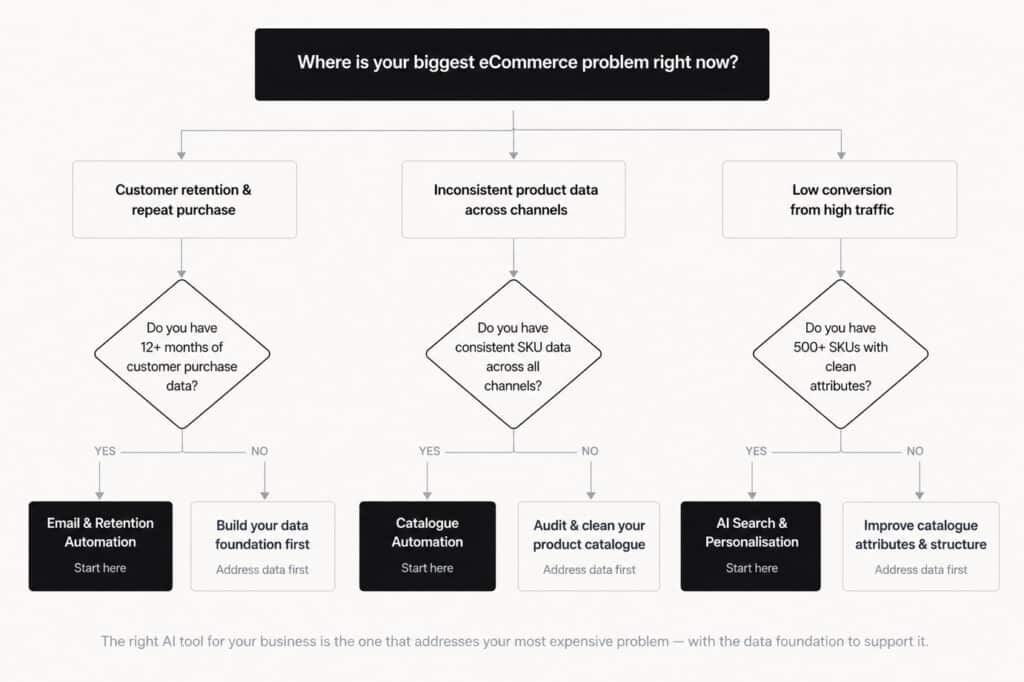
- How to decide where to start
- The question nobody asks before buying
The problem with most AI tool lists
Most “best AI tools for eCommerce” articles are structured around the tools themselves. They list twenty platforms, describe their feature sets, and leave you to figure out which one applies to your business.
That structure has a fundamental flaw: the tool is never the right starting point. The use case is.
A personalisation engine deployed on a site with three months of transaction data and no unified customer IDs will not generate a return, regardless of how sophisticated the platform is. Data quality matters more than data quantity: clean, well-labelled data outperforms massive but messy datasets. At minimum, you need 12 to 18 months of order data, web traffic analytics, and a clean product catalogue before AI models become meaningfully accurate. Shopify
For SA brands, this readiness gap is more common than the vendor landscape acknowledges. The good news is that knowing where your gaps are before you buy is itself a competitive advantage. It keeps you from wasting six months and a meaningful budget on an implementation that was never set up to succeed.
How to evaluate AI tools for an SA business context
Before getting into specific use cases and tools, three SA-specific filters should shape every evaluation.
Filter 1: Does it integrate with how SA brands actually sell? Most SA mid-market eCommerce brands operate across at least two channels: their own site (typically on Shopify or WooCommerce) and one or more marketplaces (Takealot, Amazon SA, or both). Any AI tool that only improves one channel without connecting to the others creates data fragmentation rather than resolving it. Integration with your actual stack is a non-negotiable evaluation criterion, not a nice-to-have.
Filter 2: What does the pricing model look like at SA revenue scales? Third-party AI apps typically run $20 to $500 per month. Enterprise-grade custom solutions can cost $50,000 or more to build and deploy. Many of the tools most heavily promoted in global eCommerce content are priced for US or European enterprise budgets. For an SA brand doing R5 to R50 million in annual online revenue, the ROI calculation is materially different. Evaluate tools at the revenue scale you actually operate at, not the case studies the vendor leads with. Shopify
Filter 3: Is your team set up to act on what the tool produces? Staff education determines implementation success more than technology selection. An AI-powered merchandising tool that generates daily reordering recommendations is only valuable if someone on your team has the workflow and the mandate to act on those recommendations. Before purchasing, map exactly who on your team will use the output and how. If that answer is unclear, the implementation will stall regardless of the tool’s capability. BigCommerce
Use Case 1: Personalisation and product recommendations
What it does: Personalisation AI analyses individual browsing behaviour, purchase history, and session signals in real time to surface the most relevant products for each shopper, replacing generic bestseller grids with dynamically ranked recommendations tailored to the individual.
The ROI case: Product recommendations drive up to 31% of eCommerce site revenues. Personalised suggestions can increase average order value by up to 369% when they replace generic recommendations, and conversion rates can jump by 288%. These are ceiling figures from best-case implementations. Real-world mid-market results are more conservative, but directionally consistent. Envive
Tools worth evaluating at SA scale: Nosto is the most frequently cited mid-market personalisation platform with proven ROI for brands outside enterprise tier. It learns from your catalogue and your customers without requiring a dedicated data science team to maintain it. Dynamic Yield (now owned by Mastercard) offers more sophisticated omnichannel personalisation and is worth evaluating if you have significant traffic volume and are ready for a more involved implementation. For brands on Shopify, the platform’s native recommendation features and apps like EcomRise provide accessible entry points before committing to a standalone platform.
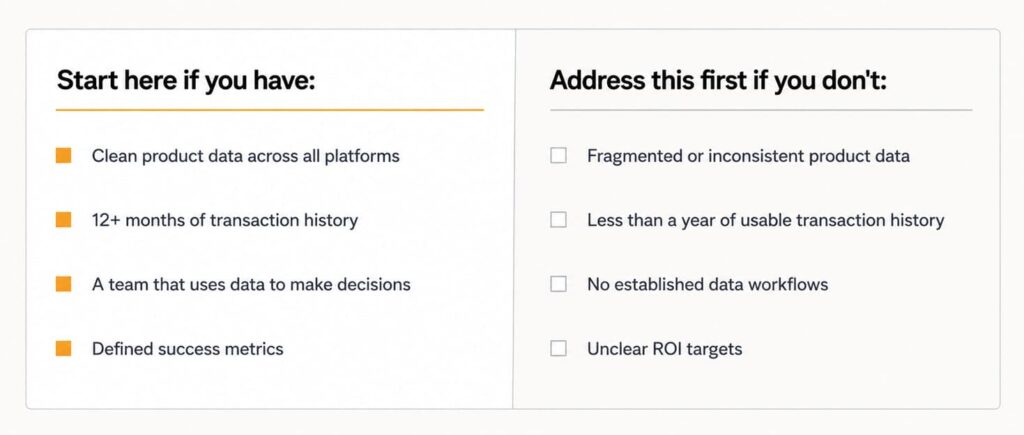
SA readiness consideration: Personalisation AI requires sufficient behavioural data to generate meaningful signals. If your site sees fewer than 10,000 monthly sessions or you have less than a year of clean transaction data, the models will not have enough to learn from. Start here only if your data foundation is in place.
Use Case 2: AI-powered search and discovery
What it does: AI-powered on-site search uses natural language processing and behavioural signals to understand what shoppers are actually looking for, including queries that don’t match exact product names, and surfaces the most relevant results. For brands with large or complex catalogues, this is often the highest-ROI AI investment available.
The ROI case: Poor on-site search is one of the most consistently underestimated conversion killers in eCommerce. Shoppers who use search convert at two to three times the rate of non-searchers, which means search quality directly determines whether your highest-intent visitors find what they need or leave. AI-powered search tools help shoppers find relevant products faster, improving both conversion rate and average order value. Fin
Tools worth evaluating at SA scale: Searchspring specialises in AI-powered site search and merchandising for mid-market eCommerce and is commonly used by brands with catalogues of 500 or more SKUs. Algolia is a developer-friendly search platform with strong AI capabilities and pricing that scales from mid-market upward. It requires more technical implementation but offers significant flexibility. Bloomreach combines search, personalisation, and content merchandising and is worth evaluating if you are ready to invest in a more integrated discovery layer.
SA readiness consideration: AI search performs best when your product catalogue is clean, consistently attributed, and well-categorised. If your product data is inconsistent across variants or your categorisation is incomplete, search AI will surface that inconsistency rather than compensate for it.
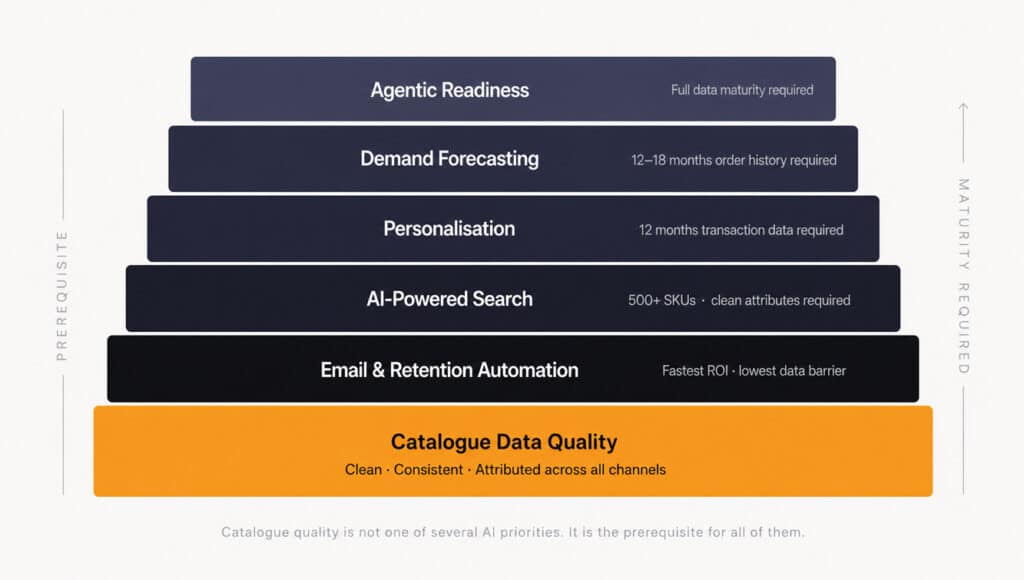
Catalogue quality is also the key driver of search and discovery performance on Takealot and Amazon SA, making catalogue management a foundational investment before search AI, not an alternative to it.
Marketplace optimisation and catalogue management
Use Case 3: Catalog automation and data enrichment
What it does: Catalog automation AI generates, enriches, and quality-checks product data at scale: producing accurate attribute sets from images, cleaning inconsistent data across feeds, translating listings, and validating content against retailer requirements. For brands managing large or frequently changing catalogues, this is the use case with the most unglamorous name and the most meaningful operational impact.
The ROI case: Clean, complete, consistently attributed product data is the foundation on which every other AI use case depends. It is also what determines whether your Takealot and Amazon SA listings rank, whether AI agents can read and recommend your products in an agentic commerce environment, and, as Google’s March 2026 core update reinforced, whether your product pages rank in organic search. Accurate attributes drive faceted filtering, which drives conversion. Correct categorisation drives recommendations. Clean specs drive marketplace eligibility. Gptprompts
Tools worth evaluating at SA scale: Modern PIM (Product Information Management) platforms with embedded AI, including Akeneo and Plytix, provide catalogue management infrastructure with AI-powered enrichment capabilities suited to mid-market brands. For Shopify brands, a range of AI catalogue apps automate product description generation and attribute completion within the platform. For brands selling on multiple marketplaces, Feedonomics provides AI-powered feed management across channels including Takealot.
SA readiness consideration: This is the use case with the lowest data-readiness barrier to entry, because the tool’s job is to improve your data, not depend on it already being perfect. For SA brands uncertain about where to start with AI, catalogue automation is frequently the highest-ROI first step because it creates the foundation every subsequent AI investment requires.
Use Case 4: Email and retention automation
What it does: AI-powered email and SMS platforms use predictive segmentation and behavioural triggers to send the right message to the right customer at the right moment, replacing batch-and-blast campaigns with automated flows that respond to individual customer behaviour in real time.
The ROI case: Automated email flows generate 30 times more revenue per recipient than standard campaigns. Klaviyo’s analysis of 325 billion emails found that 77% of email ROI comes from segmented and triggered campaigns. For most mid-market eCommerce brands, this use case delivers the fastest, most measurable return of any AI investment, because the data requirements are relatively low, the integration is straightforward on most platforms, and the revenue impact shows up in weeks rather than months. Envive
Tools worth evaluating at SA scale: Klaviyo is the dominant AI-powered email and SMS platform for eCommerce globally and integrates natively with Shopify, WooCommerce, and most major platforms. Its predictive segmentation, abandoned cart automation, and win-back flows are where most brands see immediate, trackable lift. Omnisend is a strong alternative for brands prioritising multi-channel orchestration across email, SMS, and push notifications with a simpler setup. Both are accessible at SA revenue scales and offer meaningful capability at the lower pricing tiers.
SA readiness consideration: This is the most accessible AI use case for SA brands at most stages of maturity. The minimum viable data requirement (a subscriber list with purchase history) is something most established eCommerce operations already have. If you are not yet running AI-powered email flows, this is almost certainly where you should start.
Use Case 5: Demand forecasting and inventory management
What it does: AI demand forecasting uses historical sales data, seasonality patterns, external signals, and machine learning to predict future demand at the SKU level, enabling more accurate purchasing decisions, reduced overstock, and fewer stockouts.
The ROI case: AI forecasting cuts stockouts by up to 65% and reduces forecasting errors by 20 to 50% compared to traditional methods. For SA brands managing physical inventory, whether in their own warehouse or through a 3PL, stockouts and overstock are among the highest-cost operational problems. Demand forecasting AI addresses both simultaneously, making it a high-ROI use case for brands with sufficient order history to train the models effectively. Digital Applied
Tools worth evaluating at SA scale: For Shopify brands, Shopify Flow with a third-party forecasting integration provides an accessible entry point for inventory automation. Inventory Planner is a widely used mid-market demand forecasting tool with deep Shopify and WooCommerce integration and pricing accessible to brands outside enterprise tier. For more complex multi-location or multi-channel inventory requirements, platforms like Linnworks and Brightpearl combine AI-powered forecasting with broader operational automation.
SA readiness consideration: AI forecasting requires at minimum 12 to 18 months of clean order data to generate reliable predictions. Brands in earlier growth stages or those that have recently migrated platforms will have gaps in their historical data that limit model accuracy. The tool will still function, but its predictions will be materially less reliable until sufficient data history is established. Shopify
What AI tools should SA eCommerce brands use?
The AI tools generating the most consistent ROI for SA eCommerce brands in 2026 are email and retention automation platforms (such as Klaviyo), AI-powered on-site search (such as Searchspring or Algolia), catalogue automation tools, product recommendation engines for brands with sufficient traffic and transaction history, and demand forecasting software for brands with 12 or more months of clean order data. The right starting point depends on the brand’s data maturity, platform setup, and the specific operational problem generating the highest cost or the biggest conversion gap.
How to decide where to start
Given five meaningful use cases and a landscape of dozens of tools, the practical question is sequencing: where do you invest first?
A simple decision framework:
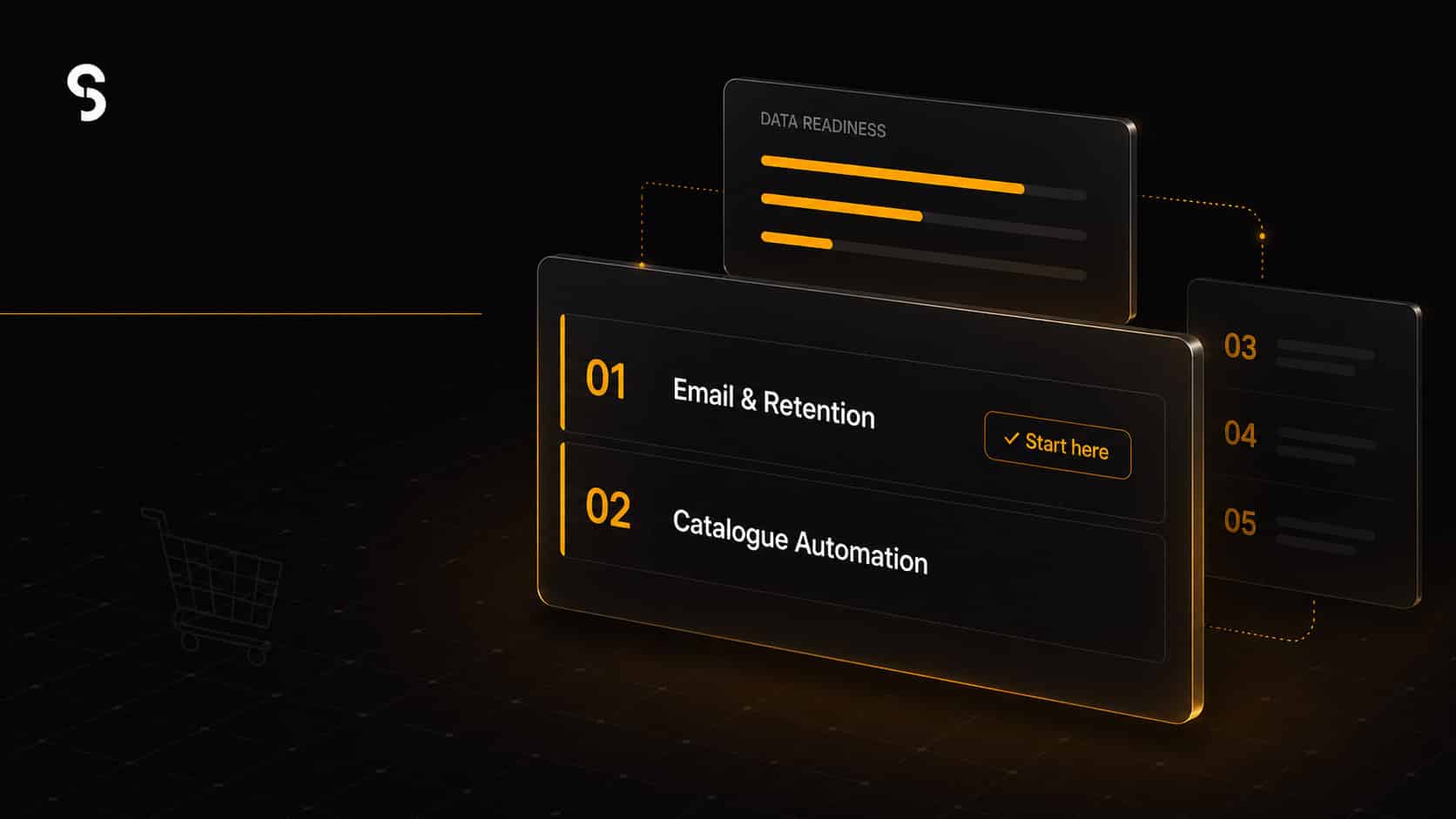
Start with email and retention automation if you have an established customer base, a functional eCommerce platform, and you are not yet running triggered, segmented campaigns. This is the fastest path to a measurable return with the lowest data-readiness requirement.
Start with catalogue automation if your product data is inconsistent across channels, your Takealot and own-site listings don’t match, or you are managing a catalogue of more than 200 SKUs without a structured data management process. Fix the foundation before anything else.
Move to AI search if you have a catalogue of 500 or more SKUs, your search function is a significant traffic driver, and your product data is clean enough for AI to surface accurately.
Invest in personalisation when you have 12 months of clean transaction data, consistent customer IDs across your platform and email tool, and a merchandising workflow that can operationalise daily recommendations.
Add demand forecasting when you have 12 to 18 months of reliable order history and stockouts or overstock are generating material cost.
Retailers are currently moving from asking “should we use AI?” to “how do we consolidate our AI tools into fewer, more integrated platforms?” The fragmentation problem (brands running six to eight point solutions) is now the primary drag on ROI, not adoption itself. The discipline that matters is starting with the use case that solves your most expensive problem, proving the return, and scaling from there. Digital Applied
The question nobody asks before buying
Most AI tool evaluations focus on features, pricing, and case studies. The question that should come first is almost never asked: is our business ready to make this tool work?
That is precisely what an AI readiness audit is designed to answer: a structured assessment of your data infrastructure, your team’s capability, and your operational workflows against the specific AI use cases that are viable and valuable for your business right now.
What an AI readiness audit covers Link
The brands that get meaningful ROI from AI in 2026 are not necessarily the ones with the biggest budgets or the most sophisticated tools. They are the ones who invested in understanding their readiness before they invested in the technology.
How do I know if my eCommerce business is ready for AI tools?
An eCommerce business is ready for AI tools when it has at least 12 months of clean, accessible transaction and behavioural data, consistent product information across all selling channels, and a team with the capacity to act on AI-generated recommendations. Businesses without these foundations are better served by addressing data quality and operational workflows first, typically through a structured AI readiness assessment, before investing in AI tools.
Not sure which AI tools are right for your business, or whether you’re ready for any of them?
Book a free 30-minute discovery call with the Saleleni team. We’ll look at your current setup (your data, your platforms, your team) and tell you honestly which AI use cases are viable for your business right now, and what a structured readiness assessment would involve.