
Most eCommerce brands are optimising for a shopper who no longer exists. The assumption baked into most product pages, category structures, and checkout flows is that a human being is doing the browsing — clicking, comparing, reading reviews, and deciding. That assumption is becoming less reliable every month. AI agents are starting to do that work instead. And they don’t shop the way humans do.
This post explains what agentic commerce is, why it’s moving faster than most brands realise, and what you need to change before the window closes.
Table of Contents
- What Is Agentic Commerce?
- How AI Shopping Agents Actually Work
- The Signal That Should Have Everyone’s Attention
- What Agentic Commerce Means for Your Product Pages
- What Forward-Thinking Brands Are Doing Right Now
- The SA Angle: Where Local Retailers Stand
- Frequently Asked Questions
What Is Agentic Commerce?
Agentic commerce is the term for a model of online shopping in which AI agents — not human shoppers — research products, compare options, and complete purchases autonomously, on behalf of a user.
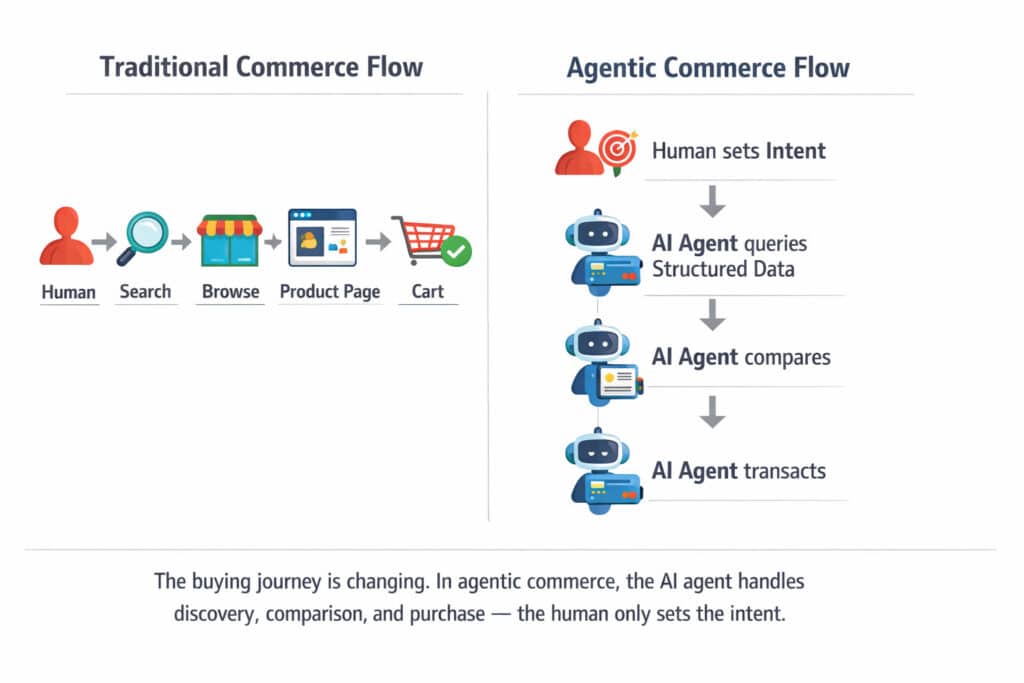
Instead of a customer visiting your site, searching your catalogue, reading your product descriptions, and deciding whether to buy, an AI agent does all of that. The human sets the intent (“find me the best cordless drill under R2,000 that ships in two days”) and the agent executes — querying multiple sources, evaluating structured product data, and transacting directly.
This is not a future concept. Shopify confirmed in late 2025 that customers can now purchase and check out directly inside ChatGPT, Perplexity, and Microsoft Copilot. The infrastructure is live.
What is agentic commerce in eCommerce?
Agentic commerce refers to eCommerce transactions initiated, researched, and completed by AI agents acting on a shopper’s behalf — with minimal or no human involvement in the browsing and buying process. Retailers whose product data isn’t structured for machine consumption risk being skipped entirely, regardless of how well their site converts human visitors.
How AI Shopping Agents Actually Work
AI shopping agents don’t browse websites the way humans do. They don’t scan hero images, respond to urgency banners, or get swayed by font choices. They parse structured data — product attributes, pricing logic, availability signals, and machine-readable specifications.
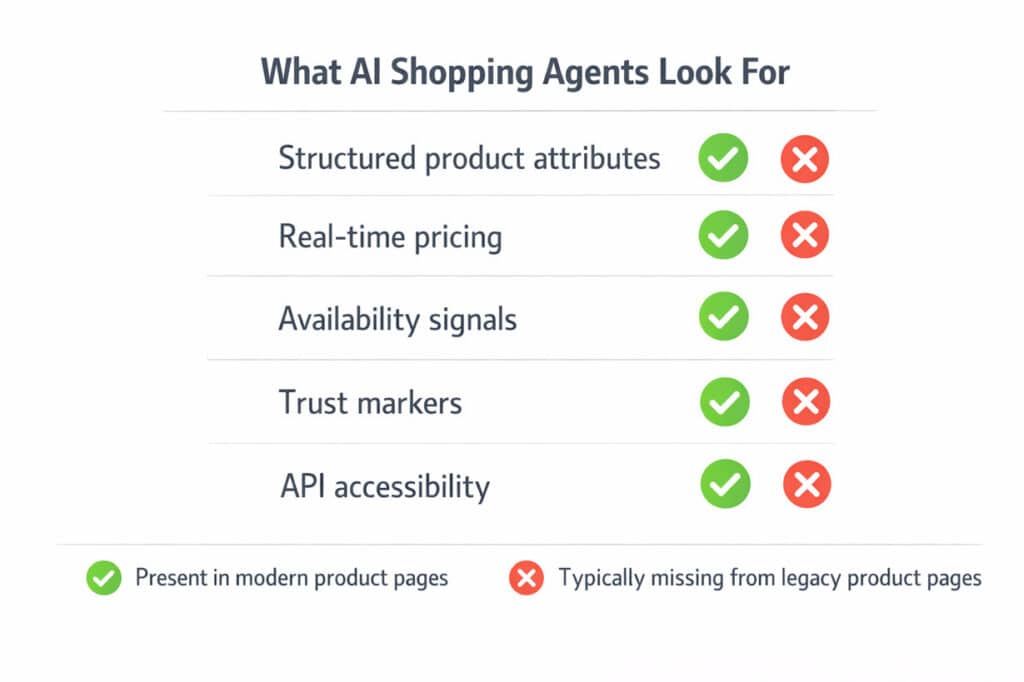
When an agent queries your product catalogue, it’s looking for:
- Clear, structured product attributes — dimensions, materials, compatibility, specifications in a consistent format
- Accurate, real-time pricing — agents discard listings with stale or ambiguous pricing
- Reliable availability signals — stock status, shipping lead times, and fulfilment options
- Trustworthiness markers — reviews, ratings, return policies, seller history
- API accessibility — whether your product data can be queried programmatically
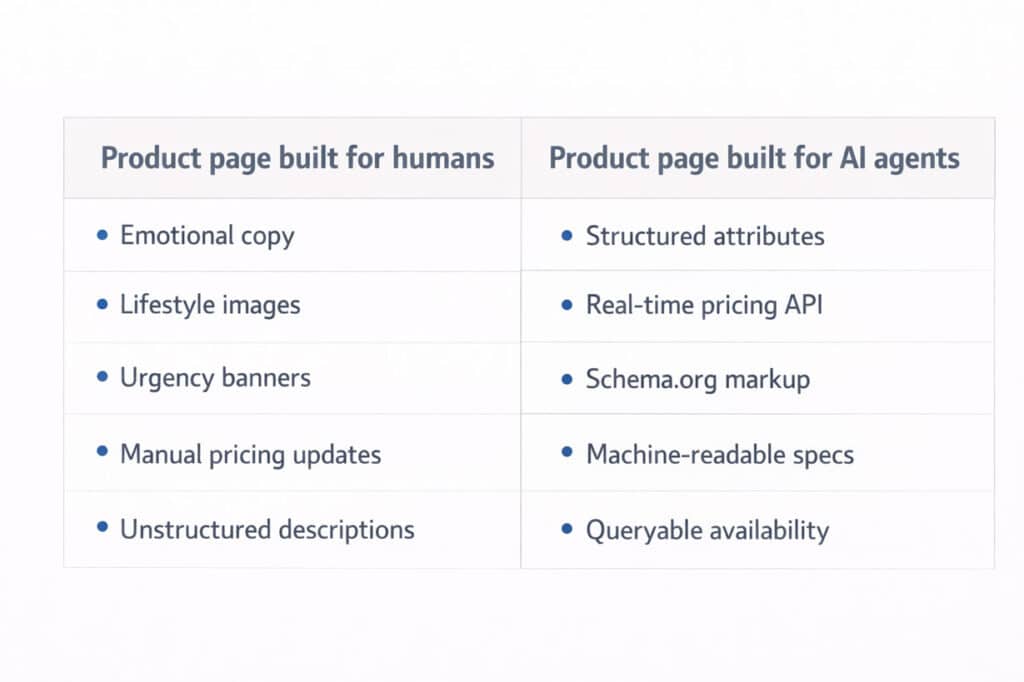
A product page built purely for human persuasion — beautiful photography, emotional copy, lifestyle imagery — may score zero with an AI agent if the underlying data architecture isn’t machine-readable.
The Signal That Should Have Everyone’s Attention
Earlier this week, Alibaba announced it had deployed autonomous AI “digital employees” to millions of merchants on Taobao and Tmall.
These aren’t AI assistants that help merchants respond faster. They are autonomous agents that handle customer queries, adjust product pricing in real time, and push vouchers — with zero human instruction, running 24/7.
Xu Haipeng, who oversees merchant platforms at Taobao and Tmall, was explicit at Tmall’s TopTalk merchant summit: the standard operating model of eCommerce will evolve into a collaboration between human and digital employees within the next one to two years.
The framing matters. Not AI-assisted. Not AI-augmented. Digital employees.
Alibaba built an entirely new business group — the Token Hub — consolidating its AI units specifically around what it calls the agentic era. This isn’t a product feature. It’s an organisational bet on where commerce is heading.
Morgan Stanley projects that nearly half of all online shoppers will use AI shopping agents by 2030, accounting for approximately 25% of their total spending. In 2025, AI-driven traffic accounted for less than 1% of eCommerce visits. The trajectory is steep.
Get The AI readiness audit for eCommerce brands
What Agentic Commerce Means for Your Product Pages
The brands that will perform well in an agentic commerce environment share one characteristic: their product data was built to be read by machines, not just humans.
Here’s what that looks like in practice:
1. Structured product catalogues
Product attributes need to be consistent, complete, and tagged correctly — not buried in long-form description text. An AI agent querying “waterproof hiking boots, size 10, under R1,800, available for delivery in Johannesburg” needs those attributes to exist as discrete, queryable fields. If your catalogue relies on unstructured copy to convey specifications, agents will pass you over.
2. Pricing and policy clarity
Agents evaluate total cost of acquisition — including shipping, returns, and lead times. If your pricing is conditional, your shipping rates are buried in a PDF, or your returns policy requires three clicks to find, agents will flag your listing as incomplete. Clarity wins, every time.
3. API-accessible product data
Platforms that expose clean product feeds — via structured APIs or formats like Schema.org Product markup — are positioned for agent discovery. If your site has no structured data layer, you’re invisible to the agents querying your category.
4. Trust signals at the data level
Star ratings, review counts, fulfilment reliability scores, and seller reputation metrics are all inputs AI agents weigh. These aren’t just human persuasion tools anymore — they’re ranking inputs in agent decision logic.
What Forward-Thinking Brands Are Doing Right Now
The brands getting ahead of this aren’t waiting for agentic commerce to hit scale before they act. They’re making structural changes now — while the window is still open and the cost of change is low.
Specifically, they are:
- Auditing their product catalogue for structured data completeness — identifying which attributes are missing, inconsistent, or buried in free text
- Implementing Schema.org Product markup across their product pages — giving search engines and AI agents structured signals to read
- Cleaning up pricing and policy pages — making fulfilment costs, return policies, and lead times machine-readable, not just human-readable
- Establishing real-time inventory data feeds — so that availability signals are accurate when agents query them
- Reviewing their platform’s API capabilities — understanding whether their eCommerce stack can be queried by external agents at all
None of these are technically complex. Most can be addressed in a structured audit without rebuilding the site.
Where Local Retailers Stand
South African eCommerce brands face a specific version of this challenge.
The dominant marketplace infrastructure in SA — Takealot in particular — already operates on structured product data. Brands that sell on Takealot have been forced to submit clean, attribute-rich catalogues. That experience is an advantage: the discipline of structured data for marketplace listings translates directly into readiness for agentic discovery.
Where SA retailers are more exposed is on their own websites. Most mid-market brand sites were built for Google search and human browsing — not for machine querying. The structured data layer that marketplaces enforce by default often doesn’t exist on owned-channel sites.
The good news: fixing this is an audit problem, not a rebuild problem. The data exists. It just needs to be structured and exposed correctly.
Frequently Asked Questions
What does agentic commerce mean for South African eCommerce brands?
For South African eCommerce brands, agentic commerce means that product visibility will increasingly depend on data quality, not design quality. Brands with clean, structured, API-accessible catalogues will be discoverable by AI shopping agents. Those relying on unstructured product descriptions and manually maintained pages risk becoming invisible to a growing share of AI-assisted buyers.
How should eCommerce brands prepare for AI shopping agents?
eCommerce brands should prepare for AI shopping agents by auditing their product catalogue for structured data completeness, implementing Schema.org Product markup, ensuring pricing and availability data is accurate and machine-readable, and reviewing whether their eCommerce platform exposes queryable product APIs. These changes don’t require a platform rebuild — most can be addressed in a structured technical audit.
Talk to us about an AI readiness assessment
The window is still open — but it’s closing
Agentic commerce isn’t a trend to monitor. It’s infrastructure being built right now, by the largest commerce platforms in the world, at operational scale.
The brands that will struggle aren’t the ones who ignored AI entirely. They’re the ones who treated it as a 2027 problem and let the structural gap widen while others closed it. Getting your product data right is the single highest-leverage action an eCommerce brand can take right now — and it’s work that pays off across SEO, marketplace performance, and agentic discovery simultaneously.
The question isn’t whether AI agents will shop your category. They already are. The question is whether they can find you when they do.
Is your product catalogue ready for AI agents?
We run structured AI readiness assessments for mid-market eCommerce brands — covering catalogue data quality, structured markup, platform API capability, and agentic commerce exposure. You’ll leave with a clear picture of where you stand and exactly what to fix.