 Saleleni
Seven out of ten shoppers who add something to their cart never complete the purchase. That’s not a rounding error — that’s the global average, sitting at 70.22% according to Baymard Institute’s 2026 analysis of over 50 studies. For most eCommerce brands, fixing cart abandonment is the single highest-leverage thing they can do to grow revenue without spending a cent more on traffic.
This post breaks down the real reasons it happens, what a high-converting checkout actually looks like, and how to diagnose exactly where your checkout is failing.
Table of Contents
- The Real Cost of Cart Abandonment
- The Top Reasons Shoppers Abandon (Backed by Data)
- What a High-Converting Checkout Actually Looks Like
- How to Diagnose Your Own Checkout Problem
- The Role of AI in Modern Cart Recovery
- Common Questions About Cart Abandonment
- What to Do Next
The Real Cost of Cart Abandonment
Before getting into fixes, let’s make the problem concrete.
At a global average of 70.22% abandonment, a store doing R5 million in monthly revenue is leaving approximately R11.7 million on the table every month — from shoppers who were already interested enough to add a product to their cart. These aren’t cold leads. They’re warm buyers who got to the door and turned back.
Globally, eCommerce retailers lose an estimated $18 billion per year to cart abandonment (Ringly.io, 2026). In South Africa, where eCommerce penetration is still growing and customer acquisition costs are rising, every percentage point of checkout conversion matters more than ever.
The good news: a meaningful portion of that abandonment is recoverable. Baymard’s research consistently shows that approximately 43% of abandoners are simply browsing — not ready to buy and unlikely to convert regardless. But the remaining 57% abandoned for fixable reasons. That’s where the opportunity is.
The Top Reasons Shoppers Abandon (Backed by Data)
1. Surprise costs that only appear at checkout
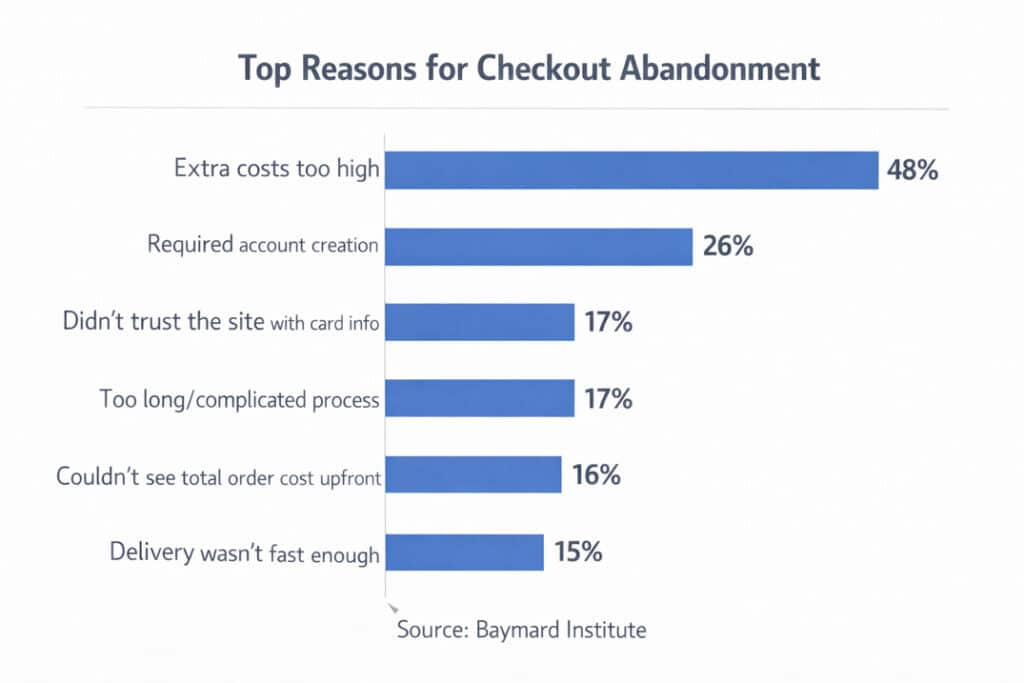
This is the number one reason — by a wide margin. 48% of shoppers abandon when unexpected fees (shipping, taxes, platform surcharges) appear at checkout after they’ve already decided to buy (Baymard Institute, 2025).
The psychology here is straightforward: they came in expecting to pay X, and you asked them to pay X plus a surprise. Trust collapses immediately.
The fix is not necessarily to eliminate shipping costs. It’s to show them early. Display estimated delivery costs on the product page. Add a shipping calculator to the cart. Show the complete order total — including VAT — before they reach the payment screen.
We see this pattern in almost every CRO audit we run. A brand will have strong product pages and weak checkout entry, and the culprit is nearly always hidden costs appearing too late in the journey.
2. Forced account creation
26% of abandoners leave because the site requires them to create an account before they can complete a purchase (Baymard Institute, 2025).
This is a self-inflicted wound. The shopper wants to buy. You want them to buy. But you’ve put an administrative hurdle between them and the purchase because you want their email address in your CRM.
Offer guest checkout. Always. If you want to encourage account creation, do it after the purchase — with a clear benefit (“Save your details for faster checkout next time”). Never before.
3. A checkout that doesn’t feel safe
17% of abandoners cite lack of trust as the reason they left — they didn’t feel confident entering their card details (Baymard Institute, 2025).
This is a signals problem. Trust badges (Visa, Mastercard, PayFast, SSL certificates), clear return policies, visible contact details, and recognisable payment methods all contribute to the sense of safety that converts hesitant shoppers. Remove any of these, and doubt creeps in.
4. A checkout that’s too long or complicated
17% abandon because the checkout process feels like too much work. Too many form fields, unclear progress indicators, confusing layout — all of these create cognitive friction that pushes people out.
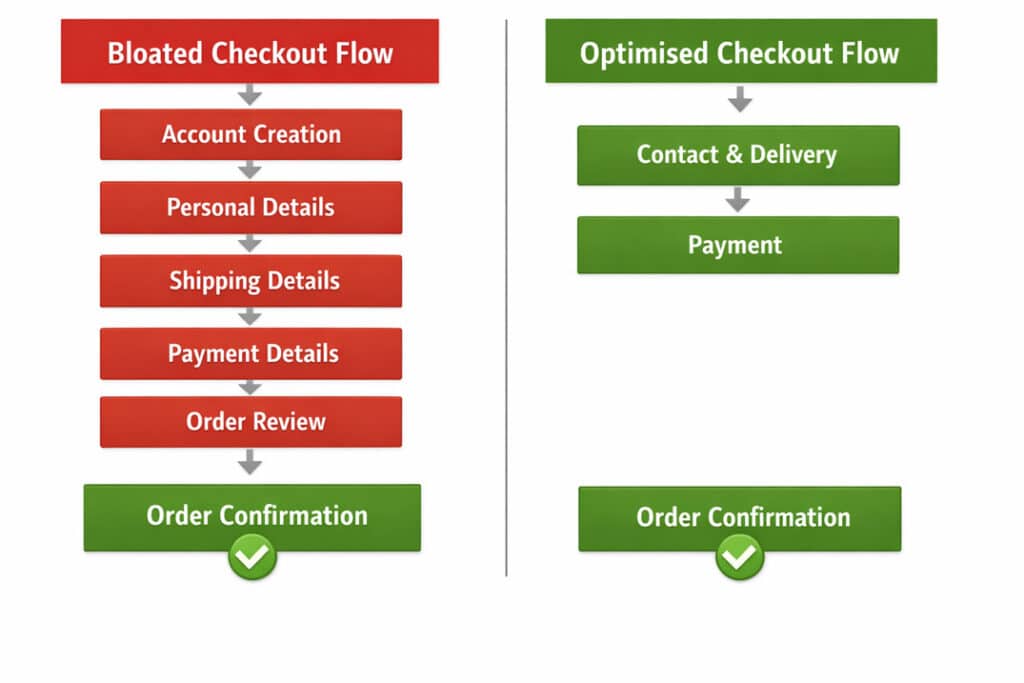
Every additional field you ask a shopper to fill in reduces the probability they’ll complete the purchase. The best checkouts ask for only what’s essential: name, email, delivery address, payment details. Nothing more.
5. Mobile checkout that doesn’t work properly
More than 60% of eCommerce traffic globally is mobile — and mobile conversion rates still lag desktop by a wide margin. A checkout that works on desktop but breaks on a small screen (tiny tap targets, fields that don’t auto-fill, payment flows that don’t support Apple Pay or Google Pay) is haemorrhaging revenue.
Mobile checkout optimisation isn’t a “nice to have” for 2026. It’s table stakes.
What a High-Converting Checkout Actually Looks Like
The highest-converting checkouts we’ve worked with share a consistent set of characteristics:
- One-page or two-step flow — minimal page transitions, clear progress indicator
- Guest checkout as the default — account creation offered post-purchase only
- Full cost transparency before payment — shipping, VAT, and any fees shown on the cart page
- Trust signals in the right places — payment logos, security badges, and return policy link visible at the payment step
- Multiple payment options — card, PayFast, Instant EFT, Buy Now Pay Later (where appropriate for the market)
- Mobile-first form design — large fields, numeric keypads for card numbers, autofill-compatible inputs
- Smart error handling — clear, specific error messages that tell the shopper exactly what went wrong and how to fix it
None of these are expensive. Most are configuration changes and UX decisions. The brands that get this right aren’t spending more on development — they’re being more deliberate about the shopper’s experience at the most critical moment in the journey.
How to Diagnose Your Own Checkout Problem
Before making changes, you need to know exactly where shoppers are dropping off. Here’s the diagnostic sequence we use in our audits:
Step 1: Set up checkout funnel tracking in GA4. Map each step of your checkout as a funnel stage — cart view, checkout start, address entry, payment entry, order confirmation. GA4’s funnel exploration report will show you exactly which step loses the most users.
Step 2: Look at your cart-to-checkout rate. If shoppers are adding to cart but not clicking “Proceed to Checkout,” the problem is on your cart page (likely hidden costs or lack of confidence). If they’re reaching checkout but dropping at payment, the problem is trust or friction in the payment flow.
Step 3: Run session recordings on checkout. Tools like Hotjar or Microsoft Clarity capture real user sessions through the checkout. You’ll see exactly where people hesitate, backtrack, or rage-click. An hour of session recordings is worth more than a week of hypothesis.
Step 4: Check your mobile vs desktop abandonment split. If mobile abandonment is significantly higher, you have a mobile UX problem. Fix the checkout experience on mobile before doing anything else.
Step 5: Survey your recent buyers. A simple one-question post-purchase survey — “Was there anything that almost stopped you completing your purchase?” — surfaces friction that data alone can’t see.
The Role of AI in Modern Cart Recovery
Fixing the checkout is the first priority. Recovery is the second.
Even a well-optimised checkout will have abandonment — that 43% of casual browsers isn’t going anywhere. The brands capturing the most recoverable revenue in 2026 are using AI-powered recovery flows that go beyond the standard “You left something behind” email.
Effective AI cart recovery in 2026 looks like:
- Personalised follow-up sequences — email and SMS timed to the individual’s browsing pattern, not a generic 1-hour trigger
- Dynamic content — showing the exact product abandoned, with real-time stock and pricing
- Behavioural intent scoring — prioritising recovery spend on shoppers most likely to convert, not blasting everyone
- AI-assisted objection handling — chatbots that surface the specific concern the shopper may have had (price? delivery? trust?) and address it directly
We’ve seen well-structured AI recovery flows recover 15–25% of abandoned carts that would otherwise have been lost. That’s not hypothetical — that’s live performance from implementations we’ve built with retailers using Dynamic Yield and similar platforms.
🔗 INTERNAL LINK Anchor text: book a free discovery call Link destination: /contact/ Placement: After the AI recovery section — “If you want to understand how this applies to your store specifically, book a free discovery call with our team.”
Common Questions About Cart Abandonment
What is cart abandonment in eCommerce?
Cart abandonment occurs when a shopper adds products to an online shopping cart but leaves the website before completing the purchase. The global average eCommerce cart abandonment rate is 70.22% (Baymard Institute, 2026), meaning fewer than 3 in 10 shoppers who add to cart actually buy. Abandonment happens at multiple points — some shoppers leave from the cart page, others during checkout itself.
What is a good cart abandonment rate for eCommerce?
There is no “good” cart abandonment rate — lower is always better. The global average is approximately 70%. Stores with optimised checkouts, transparent pricing, and strong trust signals typically see abandonment rates closer to 55–65%. Mobile abandonment rates are consistently higher than desktop, often by 10–15 percentage points.
What causes high cart abandonment rates?
The most common causes are unexpected costs appearing at checkout (shipping fees, taxes, surcharges), required account creation before purchase, insufficient trust signals at the payment step, and checkout flows that are too long or complicated. On mobile, poor UX design — small form fields, limited payment options, slow load times — is a major driver.
How do you reduce cart abandonment in eCommerce?
Reducing cart abandonment requires fixes at two levels: checkout optimisation (transparent pricing, guest checkout, streamlined form design, trust signals, mobile UX) and cart recovery (personalised email/SMS sequences, AI-powered follow-up, retargeting). The highest-impact single change most stores can make is showing full costs — including shipping — before the checkout page.
What to Do Next
Seven in ten shoppers leaving without buying is the industry average — but average is not a target. The retailers gaining ground in 2026 are the ones treating checkout as a conversion asset, not just a technical requirement.
If you’re running on decent traffic and flat conversions, the problem is almost certainly in your checkout. Not your ads. Not your product pages. Your checkout.
The diagnostic steps above will tell you where. If you want expert eyes on the data — a structured audit that maps your specific drop-off points and gives you a prioritised fix list — that’s exactly what we do.
Find Out Exactly Where Your Checkout Is Losing Sales Body: We run structured CRO audits that pinpoint your drop-off points, benchmark your checkout against best practice, and give you a prioritised list of fixes, with projected conversion impact. No generic recommendations.