On May 15, 2026, Google published its first official guide to optimising for AI search. It is the first time the company has consolidated its guidance on how content surfaces in AI Overviews and AI Mode into a single, navigable document. It was announced by John Mueller from the Google Search Relations team, which signals this is not a minor documentation update. It is a statement of position.
The guide challenges a wave of industry terminology that Google’s own representatives had been criticising for months, arriving at a moment when confusion about AEO (Answer Engine Optimisation), GEO (Generative Engine Optimisation), and a proliferating alphabet of other acronyms had reached notable intensity across the digital marketing industry.
The short version: two years of “AI search requires a new discipline” consulting has been officially contradicted by the company whose AI search product everyone was theorising about. The longer version is more nuanced, and for SA eCommerce brands specifically, significantly more useful than the hot takes currently circulating.
Here is what the guide actually says, what it means in practice, and what your business should do with it.
Table of Contents
- What Google confirmed you do not need
- What Google says actually matters
- The eCommerce-specific section nobody is talking about enough
- The traffic reality: what AI search is doing to clicks
- The one shift that changes everything for SA brands
- What to do this week
What Google confirmed you do not need
The guide opens by explicitly debunking a set of tactics that have been sold as AI search strategy over the past two years. Google’s position is unambiguous.
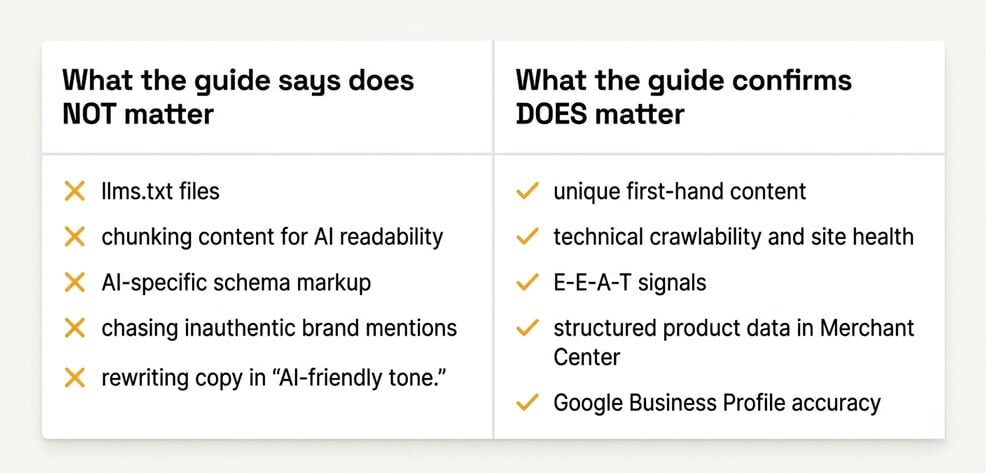
You do not need llms.txt files. The llms.txt file, proposed as a “robots.txt for language models” and adopted by many sites over recent months, is not read in any special way by Google. The crawler can discover it like any other text file, but it does not assign it meaning for inclusion in generative responses. SAP
You do not need to fragment your content into AI-readable chunks. The idea that content should be broken into micro-paragraphs to make citation in AI Overviews easier is explicitly denied by the guide. Google explains that its systems understand multi-topic pages and know how to extract the relevant passage without the author having to pre-fragment the article. There is no ideal page length, and the idea of “optimising for the chunk” often leads to skeletal content that loses editorial value without gaining any visibility.
You do not need special schema markup designed for generative AI. Standard structured data best practices apply. Nothing new was introduced.
You do not need to chase inauthentic brand mentions or rewrite your copy in a specific tone for AI systems.
On January 8, 2026, Danny Sullivan explicitly warned against fragmenting content into bite-sized chunks for LLM optimisation, saying such tactics focus on manipulating ranking systems rather than serving readers. On August 27, 2025, John Mueller issued a direct warning against using large language models to build topic clusters, stating such practices create site “liability.” The May 15 guide consolidates all of this guidance in one place. It is not a pivot. It is confirmation of a consistent position Google has held for over a year.
If your business paid for GEO consulting, llms.txt implementation, or AI-specific schema audits in the last twelve months, that is a conversation worth having with whoever sold it to you.
What Google says actually matters
The guide’s positive recommendations are, deliberately, not new. That is the point.
Unique content that only you can produce. AI systems can summarise common information quickly. That raises the standard for what deserves visibility. Content quality matters more, not less, in an AI search environment. Google is explicit that first-hand experience, original perspective, and depth that a generic AI model could not replicate on its own are the signals that influence AI citation over time. A roundup of what others have already said does not meet this bar. Intelligent CIO LATAM
A technically clean, crawlable site. Content still needs to be indexed, crawlable, and eligible to appear with a snippet in Google Search. If a page cannot be properly discovered, processed, or rendered, it is not in a strong position to appear as a supporting source in AI-generated results. Core Web Vitals, page experience, and crawl hygiene all remain relevant. Nothing has changed here except the stakes.
E-E-A-T signals, consistently applied. Experience, Expertise, Authoritativeness, and Trust are the signals AI systems are reading when evaluating whether a source is worth citing. These are not built through a single optimisation sprint. They are built through a pattern of publishing credible, original, well-structured content over time.
Research from Semrush published in June 2025 found that AI search visitors are worth 4.4 times more in economic terms than traditional organic search visitors, which suggests that while AI features may reduce total click volume, the clicks that do occur carry higher commercial value. The brands building E-E-A-T consistently are not just protecting their search presence. They are attracting higher-value visitors when they are cited. Bandwidth Blog
The eCommerce-specific section nobody is talking about enough
Most commentary on this guide is focused on the content and SEO implications for publishers and bloggers. The eCommerce section of the guide is being largely under-reported, and it contains the most immediately actionable guidance for SA brands.
AI Mode integrates product listings and Google Business Profile information directly into responses. Google identifies as technical channels Merchant Center with structured feeds, an updated Business Profile, and the new Business Agent, the conversational experience that lets customers chat with an AI agent on behalf of the store. BigCommerce
This is a significant shift in how to think about your Merchant Center feed. It is no longer just a Shopping Ads infrastructure tool. It is a direct input into AI-generated search responses.
In traditional Google Shopping, a clever bidding strategy could compensate for mediocre product data. In Google AI Shopping, product data quality is the primary ranking signal. Backlinks and domain authority matter far less when the AI is reading structured feeds rather than crawling web pages. RBM Software
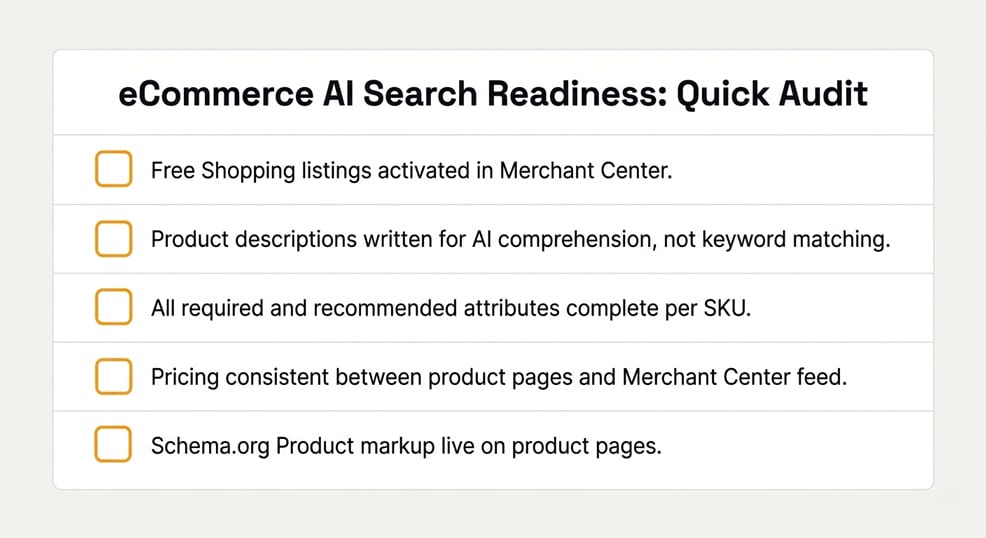
What this means practically: a product with 5 attributes will lose to a competitor with 25 attributes when the consumer asks a detailed question. Write descriptions for AI comprehension. AI Mode needs to understand what your product is, who it is for, and how it compares to alternatives. Natural language descriptions that answer common consumer questions outperform keyword-stuffed SEO copy.
For eCommerce brands selling on their own site and on marketplaces, this creates a specific vulnerability. Product descriptions that were written for keyword matching, copied from supplier sheets, or left at the minimum viable length for a Shopping ad are now actively underperforming against competitors whose product data reads like editorial copy.
Short, generic product cards lose ground compared to descriptions that talk about materials, use cases, and differences from competitors.
A second point from the guide that most coverage is missing: Google explicitly confirmed that free Shopping listings, not paid Shopping ads, are the primary surface AI Mode reads from. Many retailers run paid campaigns without activating the free listings toggle in Merchant Center settings. AI Mode reads from free listings. Without that toggle, products cannot appear in AI Mode organic results. If you are running Shopping ads but have not explicitly activated free listings in your Merchant Center account, check this today. Fin
The traffic reality: what AI search is doing to clicks
The guide is clear about what to do. It is less comfortable about what is also true in parallel.
48 percent of searches on Google in March 2026 already display an AI answer at the top of the page, up from 34.5 percent in December 2025. AI answers are not a niche feature. They are the default experience for roughly half of all searches right now. SAP
The click data is not simple. Ahrefs documents a 58 percent lower CTR on the top-ranking page for AI Overview keywords. Pew Research measures an 8 percent click rate with an AI Overview present versus 15 percent without. Traditional position-one rankings are generating materially fewer clicks in queries where an AI answer is present.
The counter-signal matters too. Sites cited in AI Overviews benefit substantially. Seer Interactive documents 120 percent more organic clicks per impression for cited brands compared to non-cited ones, and a consistent advantage of roughly 4 percentage points in paid search CTR throughout all of 2025.
The pattern is clear: being present in the search results is becoming less valuable. Being cited in the AI answer is becoming significantly more valuable. The brands that built credible, original content over time are not just protected from AI Overview cannibalisation. They are being disproportionately rewarded by it.
There is meaningful relief for eCommerce specifically. eCommerce queries see AI Overviews only 4 percent of the time in 2026, down from 29 percent when the feature first rolled out. Google appears to recognise that product searches require clicking to complete transactions, preserving the commercial SERP structure. The click-cannibalisation risk is significantly lower for transactional product queries than for informational ones. The Merchant Center and AI Mode exposure discussed above is a separate surface from AI Overviews, and the two should not be conflated.
What does Google’s AI optimisation guide say about appearing in AI Overviews?
Google’s AI optimisation guide confirms that appearing in AI Overviews and AI Mode requires the same foundations as traditional SEO: unique, credible, well-structured content, a technically clean and crawlable site, and strong E-E-A-T signals built over time. Tactics marketed specifically for AI search, including llms.txt files, content chunking for AI readability, and AI-specific schema markup, are explicitly identified as unnecessary. For eCommerce brands, Google Merchant Center feed quality and completeness are identified as the primary technical lever for visibility in AI-powered shopping surfaces.
The one shift that changes everything for SA brands
The guide does not change the rules. It clarifies that the rules were always the same, and that two years of “AI search is different” consulting obscured rather than illuminated that fact.
For SA eCommerce brands, this has a specific implication that global commentary is not addressing.
Most SA mid-market brands have been running a content strategy and a product data strategy as two separate disciplines. The content team publishes blog posts and category copy. The eCommerce team manages the Merchant Center feed. The two rarely talk.
Google’s guide collapses that distinction. The AI systems reading your product feed and the AI systems evaluating your editorial content are feeding the same AI Mode response. A technically complete Merchant Center feed alongside thin, generic product descriptions is an inconsistent signal. Rich editorial content on a site with an incomplete product feed is a missed commercial opportunity.
The brands that will perform best in AI search over the next twelve months are the ones that treat product data, editorial content, and technical SEO as a single integrated strategy, not three separate workstreams with separate owners.
This is exactly the kind of integrated work that marketplace optimisation and catalogue management supports, treating your product data as a content and commercial asset, not just an operational requirement.
Marketplace optimisation and catalogue management
What to do this week
Based on what the guide actually says, here is a prioritised action list for SA eCommerce brands.
Immediate (this week): Log into Google Merchant Center. Confirm that free Shopping listings are activated under Growth > Manage Programs. This takes five minutes and is the single highest-leverage technical action for AI Mode visibility. Check that your pricing in Merchant Center matches your product page pricing. Inconsistencies between the two are flagged as unreliable data by Google’s systems.
Short-term (next 30 days): Audit your ten best-selling products against the question: does this description explain what the product is made of, who it is for, and how it differs from alternatives? If not, rewrite it. That rewrite improves your Merchant Center feed, your product page, your AI Mode eligibility, and your Google Shopping performance simultaneously.
Structural (next quarter): Map where your content and your product data teams are working in silos. The guide makes clear that both feed into the same AI response surface. An organisation that treats them as separate is leaving a compounding structural disadvantage in place.
If you are uncertain where your biggest gaps are across content, product data, and technical SEO, a structured AI readiness assessment is the most efficient way to find out, and to get a prioritised response plan that is specific to your business rather than generic industry advice.
What an AI readiness assessment covers
Is Google’s AI optimisation guide relevant for South African eCommerce businesses?
Yes. Google’s AI optimisation guide is directly relevant to South African eCommerce businesses, particularly those selling through their own website and on marketplaces like Takealot and Amazon SA. The guide’s eCommerce-specific guidance covers Google Merchant Center feed quality, product description depth, and free Shopping listings activation, all of which affect how SA brands appear in AI Mode product recommendations. The SA market operates on the same Google infrastructure as global markets, meaning the AI search shift is already live and affecting visibility for local brands now.
Not sure how your site and product data are positioned for AI search?
Book a free 30-minute discovery call with the Saleleni team. We will look at your content, your Merchant Center setup, and your technical foundations, and tell you honestly where your gaps are and what a structured response would involve for your specific operation.