 Saleleni
Now that the Google Marketing Live 2026 buzz has calmed down a bit, let’s quickly go through what was announced and how you should feel about it (and definitely also do something about it).
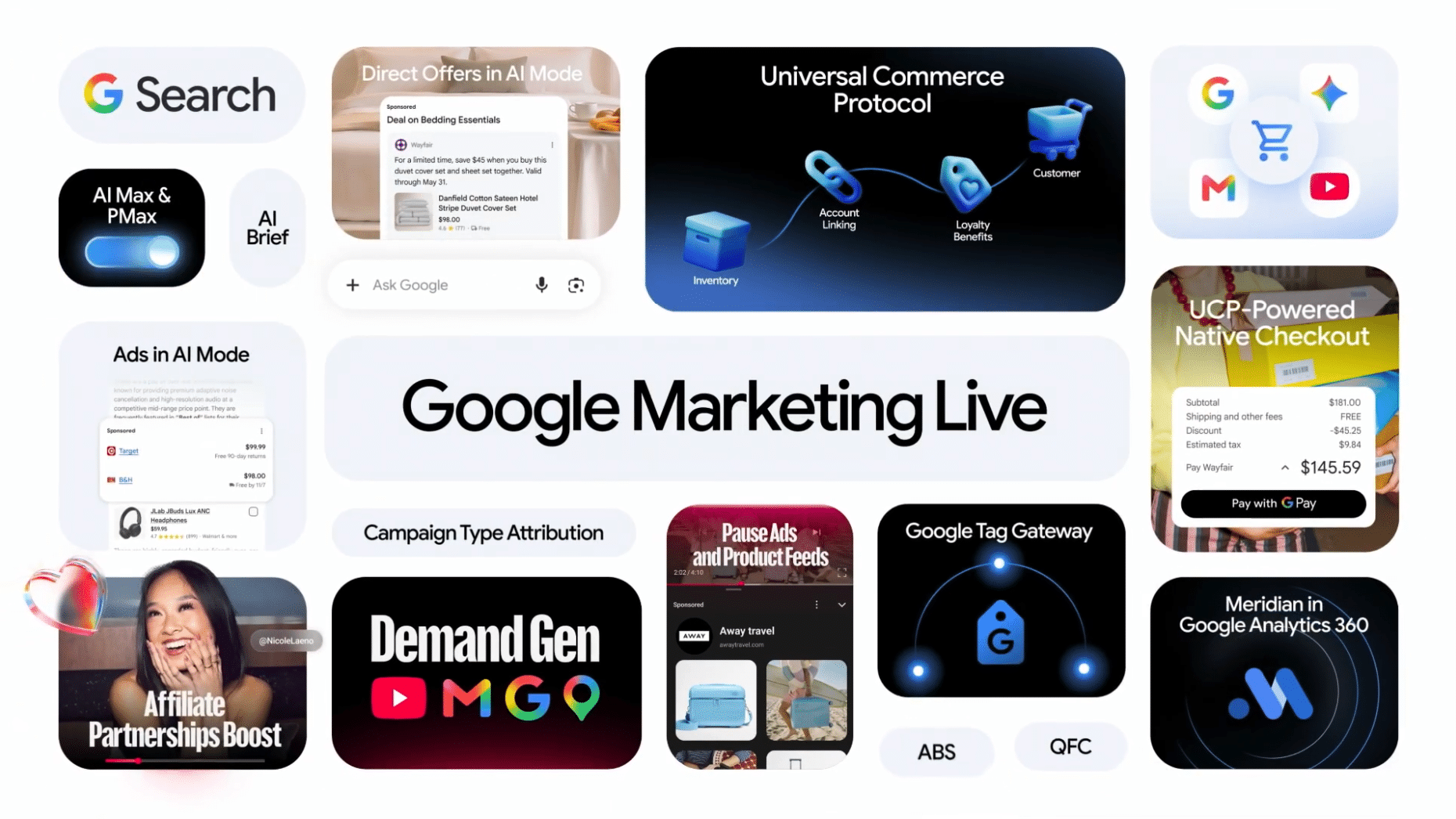
Here’s the interesting list first, the spicy bits:
- Demand Gen expanded to Google Maps
- Product Feeds expanding to tablets and pause ads on YouTube
- AI Mode ads to go live: these are ads with copy generated dynamically by Gemini to match the conversation (so beyond just the keyword)
- AI Max for Search is now global and out of beta
- Dynamic Search Ads are being retired. These will be auto-migrated to AI Max in September 2026
- AI Brief launched: plain language brand guidelines that instruct how Gemini writes your ads
- Universal Cart rolled out: a persistent cross-merchant cart across Search, Gemini app, YouTube, and Gmail
- Universal Commerce Protocol (UCP) expanded: big dogs like Amazon, Meta, Microsoft, and Salesforce have joined
- Direct checkout in ads via UCP: buy directly from an ad without leaving Google. Agentic is inevitable
- Ask Advisor launched: one unified AI agent across Google Ads, Analytics, Merchant Center, and Google Marketing Platform
- Asset Studio upgraded with Gemini Omni for video and image generation at scale
- Meridian (marketing mix modelling) integrated into Google Analytics 360
- Qualified Future Conversions (QFC) introduced: a predictive metric for long-term campaign value
- Attributed Branded Searches (ABS): a real-time signal that your ad created upstream intent
Quite a long list of announcements and updates. With this, Google signalled going beyond just a platform to becoming the transaction layer for eCommerce. Discovery, comparison, checkout, and loyalty, all inside Google’s ecosystem. For example, the Universal Cart and UCP are not features, they are infrastructure. This also confirms what we’ve been saying, and hopefully you have started acting: Thin, inaccurate, or incomplete Merchant Center product feeds will result in your products not surfacing in the agentic shopping experiences being built by Google (and other platforms Of course). Better take action here now.
The second thing that matters is September.
If you are running Dynamic Search Ads today and you do nothing, Google will migrate your campaigns to AI Max automatically in three months. Not a problem if your data and brand inputs are clean, and a very big one if they are not, because AI Max will bid and write and optimise based on what it can find. If your site, your feeds, and your first-party data signals are weak, the machine will likely make poor decisions.
What is an AI readiness assessment and what does it cover?
The third thing is measurement.
QFCs and ABS are genuinely useful, but they are Google-only signals. If your customer journey runs across Meta, LinkedIn, email, and organic before converting on Google, QFCs give you a partial picture. Treat them as one input alongside your MMM and incrementality data, not as a replacement.
Quite a lot and a bit overwhelming, huh?!
Do this this quarter. This is in order of urgency:
- Audit your Merchant Center feeds. Rich, accurate, structured product data is the biggest lever in agentic commerce. It determines whether your products show up in AI Mode, in the Universal Cart, and in Demand Gen placements. If your feeds are weak, fix this first.
2. Migrate DSA to AI Max. Do not let Google do it for you in September with no context. Take the migration on your terms, set up your AI Brief with proper brand guidelines, and give the system the inputs it needs to perform.
3. Set up Google Tag Gateway and connect Data Manager. The compounding effect of better first-party signals is real. Doc Martens saw a 16% revenue jump immediately after feeding first-party data into Performance Max. This is table stakes now, not advanced practice.
4. Add Demand Gen if you are only running Search and PMax. Adding it drives 10% higher ROAS and 12% better sales efficiency on average. Plus it now runs on Google Maps, which is a genuinely different audience moment.
If you are not sure where your Google ecosystem stands, start with the feeds and work backwards.
Still not sure?
Book a free 30-minute discovery call with the Saleleni team.